
How to Search Antrim County Court Records
Records in Antrim County are split across three trial courts and a few record desks. The county homepage and its online services page point searchers to two main tools. The first is the 13th Circuit Court case system for civil and criminal files. The second is the 86th District Court case links for lower-level matters. The job is not to guess. It is to decide whether a file is circuit or district, and whether the case is civil or criminal. Felonies and larger civil suits live in the circuit system. Misdemeanors, traffic, and small claims sit in the district system. Probate and family files run through a separate court in downtown Bellaire.
The county lays out these tools on its online services page, which links the circuit and district case systems in one place.
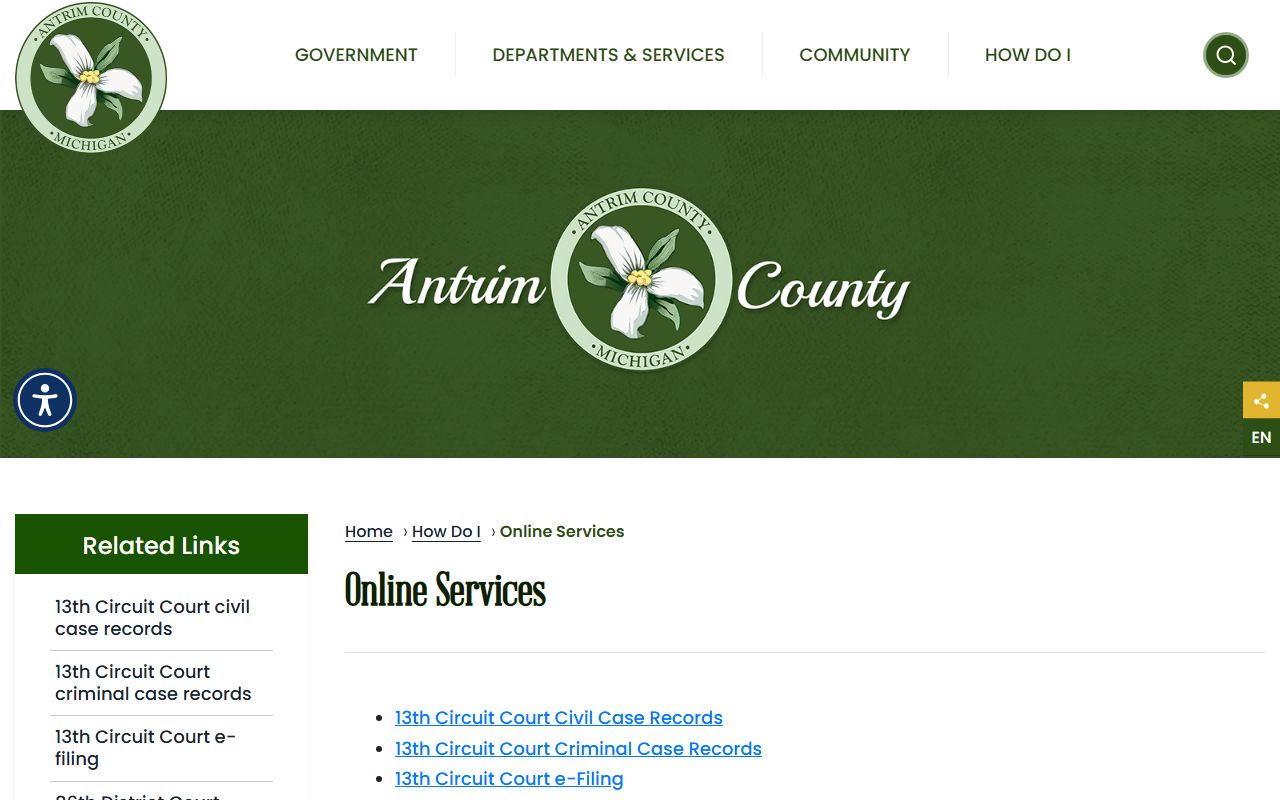
That single hub saves a trip, since it gathers circuit records, district cases, and register of deeds search options together. Have a few details ready before you begin. A full name helps. A case number helps more. Both circuit portals accept either one, and both are free to use.
- Decide whether the record sits in circuit, district, or probate court.
- Decide whether the case is civil, criminal, traffic, probate, or domestic.
- Open the portal the county links for that court.
- Search by party name first if you do not know the case number.
- Choose Antrim from the county dropdown when the system asks for it.
- Open the result to read the judge, filing date, status, and proceedings.
- For files older than the portal range, ask the records office or check microfilm.
The 13th Circuit civil case search covers Antrim, Grand Traverse, and Leelanau counties in one database.
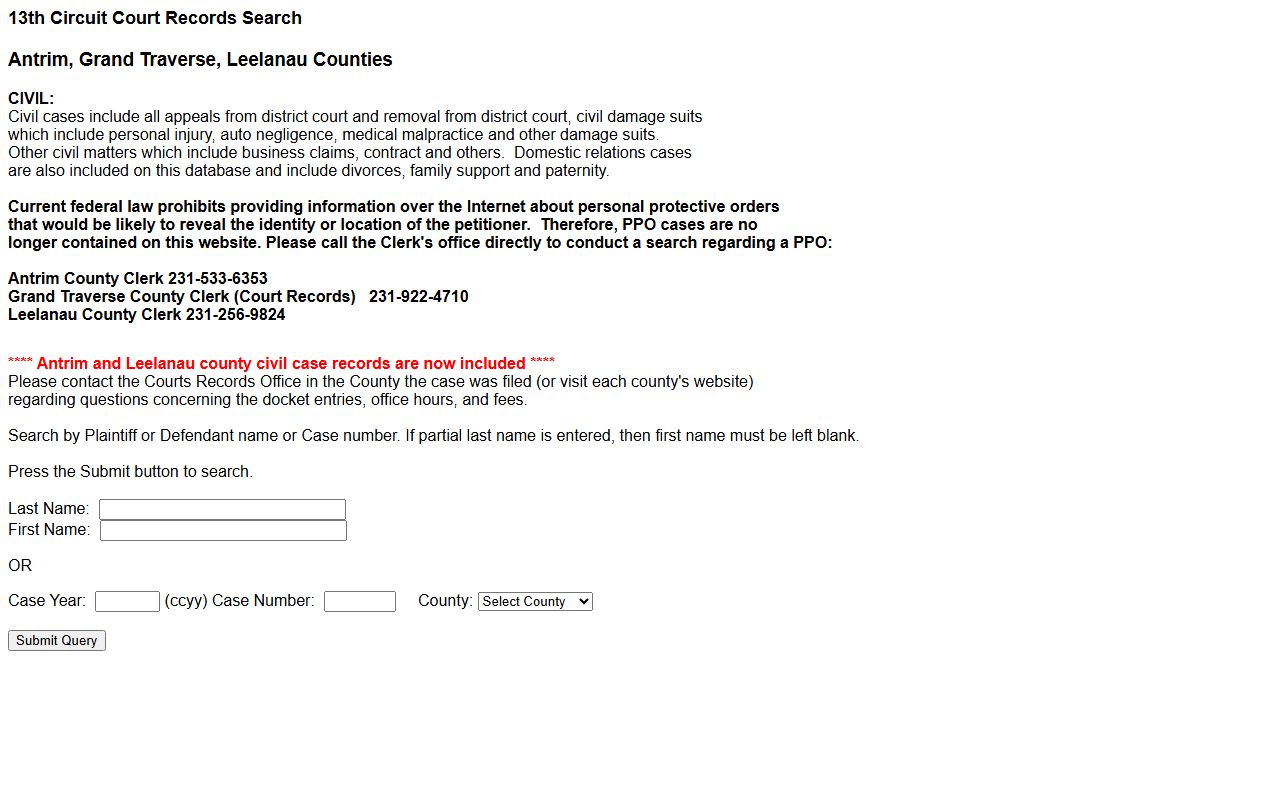
Civil results list the party name, case number, case type, and county, so you can confirm the right file before you open it. The civil search form uses a small set of fields.
| Field Label | Type | Required | Format Notes |
|---|---|---|---|
| Last Name | Text | Common start point | Partial last name allowed if first name is blank |
| First Name | Text | No | Leave blank when using a partial last name |
| Case Year | Text | Optional | Four digits, format ccyy |
| Case Number | Text | Optional | Five digits |
| County | Dropdown | Yes for number search | Antrim, Grand Traverse, or Leelanau |
| Submit Query | Button | Yes | Runs the search |
Note: If you enter a partial last name in the circuit portals, leave the first name blank, or the search will not return a match.
The Antrim County Judicial System
Michigan keeps a simple trial structure with three court types: circuit, district, and probate. Antrim County sits inside the 13th Circuit Court district with Grand Traverse and Leelanau counties. The 86th District Court serves the same tri-county area. Probate and family cases are handled in the probate division in Bellaire. The county clerk acts as the records hub for the circuit court, while the district court runs its own contact and case pages.
Appeals climb a clear ladder. Final circuit and probate orders go to the Michigan Court of Appeals, where Antrim County falls in the Fourth District. The Michigan Supreme Court sits above that as the state's high court. Federal cases from the county are filed in the U.S. District Court for the Western District of Michigan, Southern Division. No justice-of-the-peace or municipal court was found in the county materials.
The county's courts landing page gathers the circuit, district, and probate links in one spot.
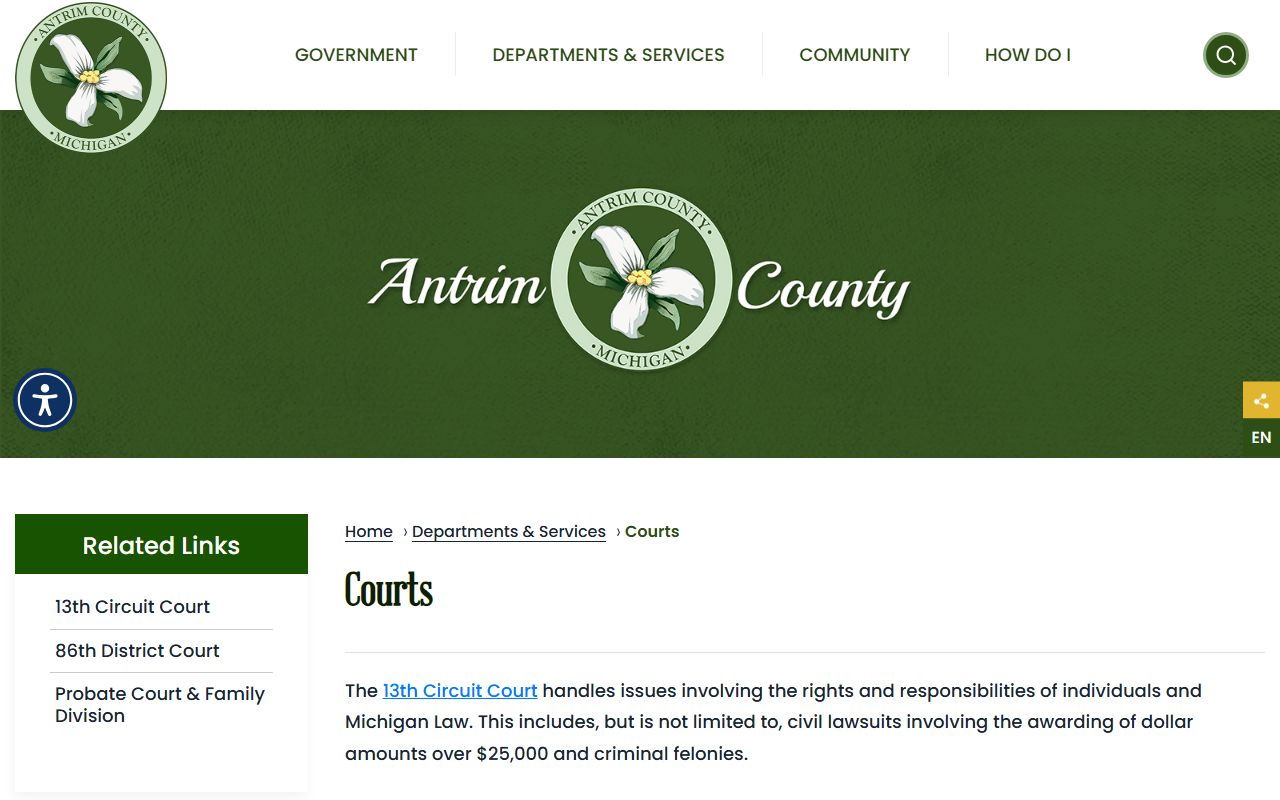
That page is the plain-English map of the local court cluster, which helps a first-time searcher land in the right system.
Case flow: Circuit Court › Court of Appeals › Michigan Supreme Court. District Court › Circuit Court for many appeals and transfers.
| Court | Jurisdiction | Case Types |
|---|---|---|
| 13th Circuit Court | Antrim, Grand Traverse, Leelanau | Felonies, family, larger civil, appeals from district |
| 86th District Court | Same tri-county area | Misdemeanors, traffic, civil infractions, small claims |
| Probate and Family Division | Antrim County | Estates, guardianships, conservatorships, adoptions |
| Michigan Court of Appeals | Fourth District | Appeals from circuit and probate orders |
Antrim County Courthouse and Court Offices
The three trial courts share the historic courthouse in downtown Bellaire at 205 E Cayuga St. The county clerk, who keeps the circuit files, sits next door at 203 E Cayuga St. The sheriff and jail are a short drive away on Portage Drive, so the courthouse and the jail are not the same building. That tight Cayuga Street core is the practical campus for most public users.
Probate Court and Family Division
205 E Cayuga St, PO Box 130
Bellaire, MI 49615
231-533-6681
Types of Court Records Available in Antrim County
Antrim County public records span several venues, and the same case type does not always live in the same office. The clerk, the circuit search portal, the district court pages, and the probate pages each hold a piece. The county also keeps sheriff records, vital records, and deed records that are often confused with court files but are not the same thing.
The tri-county civil and criminal records search page explains the coverage and the office ranges behind the portals.
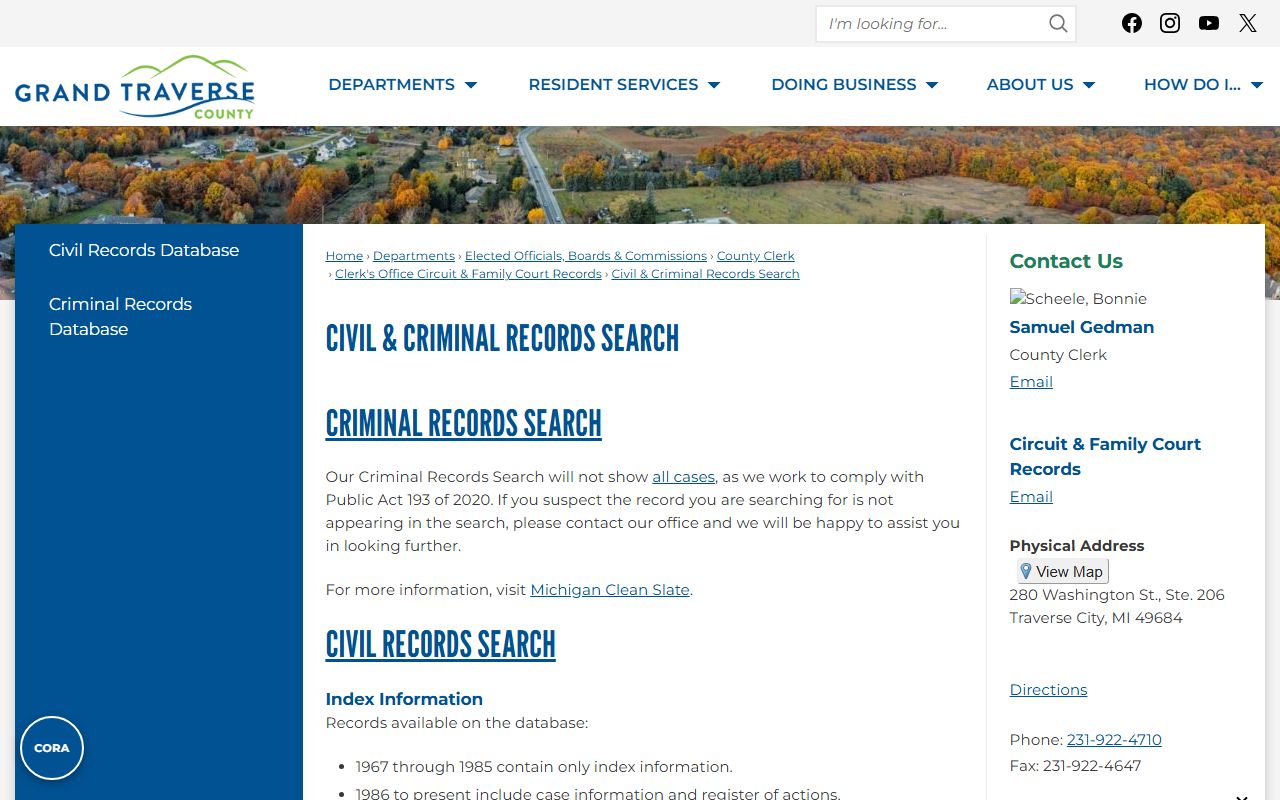
That overview is useful because it flags which years and which case types the public database actually returns. The main record groups break down like this.
- Criminal records cover felony complaints, pleas, trials, and sentencing kept in the circuit system.
- Civil records include damage suits, contract claims, and appeals removed from district court.
- Family records hold divorce, custody, support, and paternity files, some of them protected.
- Probate records track estates, guardianships, conservatorships, and name changes.
- Traffic records and civil infractions sit in the 86th District Court.
What Antrim County Court Records Show
The circuit search results and case-detail pages show the shape of a real county file. Civil cases use case numbers such as 2013-6575 DO, with type codes like DO for divorce. Criminal cases use a like format, such as 2015-1877 FC for a felony. The forms ask for a name or a case number. The detail pages then add the judge, the filing date, the close date, the disposition, and a docket-style list of proceedings. That is enough to trace a case from filing to outcome.
| Field | What It Shows |
|---|---|
| Case Number | The unique file ID plus a case-type code such as DO or FC |
| Filing Date | When the case was issued or opened with the court |
| Parties | Plaintiff and defendant, or the charged defendant in a criminal file |
| Judge | The judge assigned to the case |
| Charges or Cause | The offense counts or the civil claim behind the case |
| Disposition | The end result, such as a judgment, plea, or dismissal |
| Sentence or Judgment | The final order or the punishment imposed after conviction |
The criminal detail page splits the offense and sentencing table from the proceedings log. That gives readers the two things they most want to know: what the charge was, and what the court did with it. Fields there include count, plea, conviction, offense statute, degree, and the assigned prosecutor and defense attorney.
The 13th Circuit criminal case search is the public route to those criminal files.
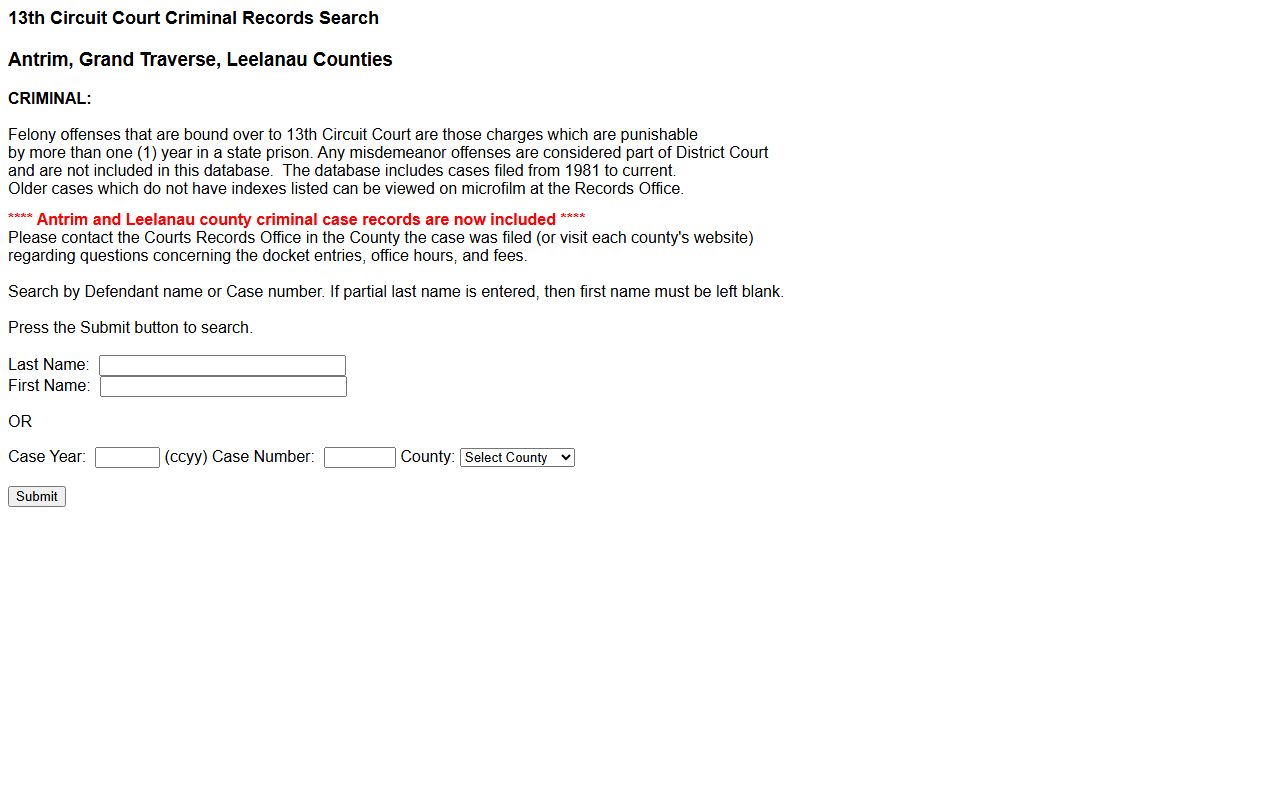
Criminal results add the defendant name, the district court case number, and the county, which helps sort common names apart.
Public Access Laws for Antrim County Court Records
Residents do not get records from a statute alone. They get them from the office that holds the file, with the statute standing behind that local policy as authority. For county records, the FOIA page is the public-facing start point. For court files, the clerk or records office is the right door, and the free circuit portal often answers the first question before any request is needed.
Key Statutes:
MCL 15.231 et seq. gives the public a right to inspect government records unless a listed exemption applies.
MCL 15.243 lists the FOIA exemptions a public body may use to withhold personal or protected information.
MCR 1.109 defines what counts as a court record and what personal data must be shielded in filings.
MCR 8.119 sets how trial courts manage records and which items stay off the public online view.
MCL 780.621 is the main state expungement law for setting aside eligible convictions.
MCL 28.241 governs how Michigan keeps and shares criminal-history identification records.
The Michigan judiciary explains how the trial courts fit together on its statewide courts overview.
That overview places the county's circuit, district, and probate courts under the same rules that govern public access statewide.
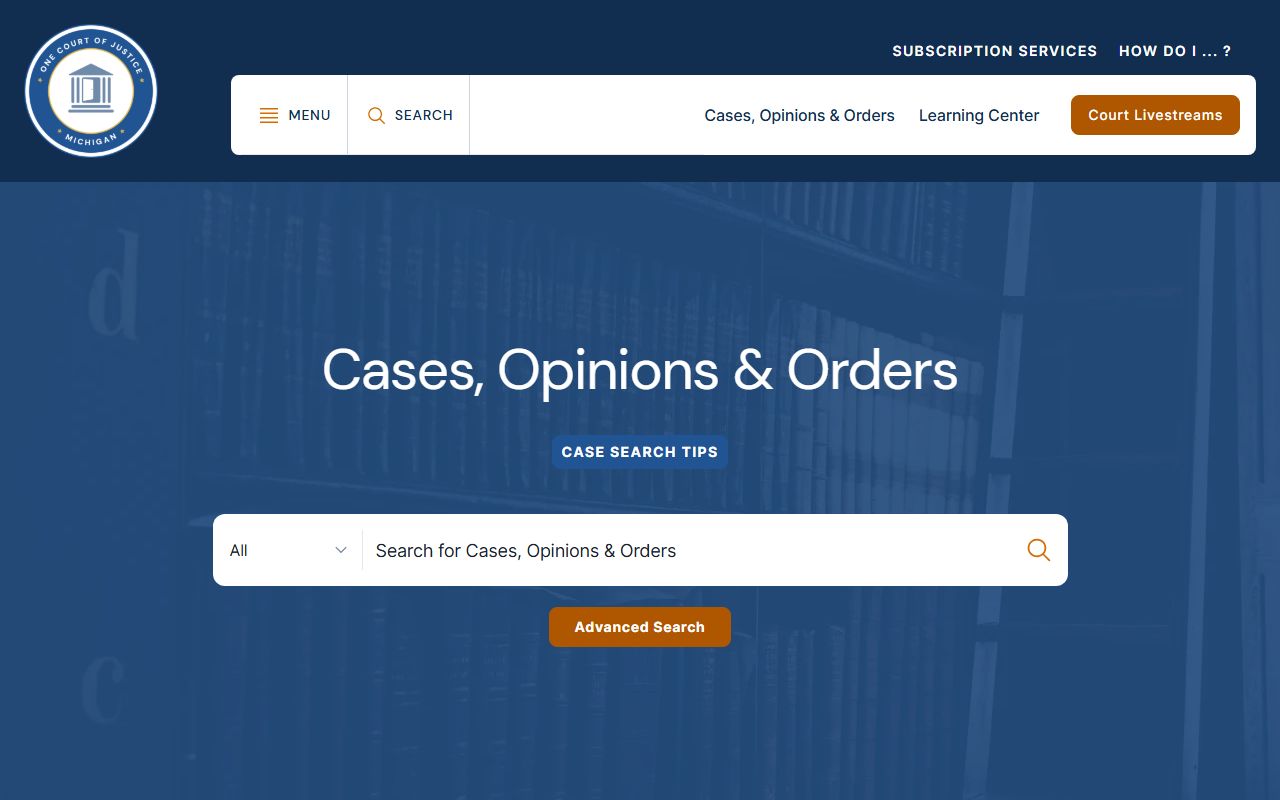
The state also runs its own public search tools. The Michigan judiciary posts a broad case and opinion search for appellate matters.
Court files stay open unless a judge seals them, and personal identifiers in public files must be redacted. That is why a case can be visible while a single attachment is not.
Note: County FOIA requests may be mailed, emailed, faxed, hand delivered, or filed through the online form the county publishes.
Records That Are Restricted or Confidential
Some files are open and some are not. The clearest example is the civil circuit portal, which no longer lists personal protection order cases because federal law blocks online disclosure that could reveal a petitioner's identity or location. Court rules also shield birth dates, Social Security numbers, driver's license numbers, passport numbers, and financial account numbers. The public can often see the case, just not every line in it.
Several whole categories stay closed. Most juvenile case records are not fully public, and certain mental-health proceedings carry their own confidentiality rules. Adoption records, sealed files, and expunged convictions also fall outside routine public view. Petitioning to clear or view a protected record follows a set path.
- Check whether the record is actually eligible under Michigan's expungement statutes.
- Confirm the waiting period and any conviction-count limits.
- Prepare the petition and the required supporting documents.
- File with the correct court and pay the filing fee.
- Submit any fingerprints, background information, or disclosure forms.
- Attend the hearing if the court sets one.
- If relief is granted, the record is set aside and public access changes at the source.
Specialty Courts in Antrim County
Antrim County does not run a long catalog of specialty-court landing pages of its own. The tri-county district and circuit materials do show real treatment dockets, though, and they serve county residents. These problem-solving courts aim to cut repeat offenses and offer supervised alternatives to jail. Domestic violence, sobriety, and mental-health dockets are the main themes found in official sources.
Each program has a clear focus and its own eligibility path. The strongest documented examples include the following.
- Sobriety Court is a recovery court for drunk-driving offenders, started in 2001 and offered at the Antrim location.
- Domestic Violence Court handles misdemeanor domestic-violence charges on a fast-tracked docket for Antrim and Grand Traverse counties.
- Mental Health Court began in 2009 and gives an alternative to jail for people with mental illness in the criminal system.
- Drug Treatment Court started in the fall of 2016 and focuses on felony drug convictions as a jail alternative.
Antrim County Sheriff and Jail
The Antrim County Sheriff's Office is led by Sheriff Kevin S. Hoch, with the office on Portage Drive and the jail on E Cayuga Street in Bellaire. The correctional facility was built in 1955, has been renovated over time, and is rated to hold 56 inmates by the state. It runs around the clock with a full team of corrections deputies, sergeants, a jail administrator, and medical staff. The lobby vestibule stays open 24 hours under surveillance.
The county does not publish a public jail roster on the pages reviewed. Instead, the sheriff site routes families to vendor services and to a submit-a-tip form for possible crimes or wanted-person leads. For custody detail, booking questions, and the service links, see the full Antrim County inmate records page, and for outstanding warrants and the fallback channels, check the warrant records page.
The county homepage keeps the sheriff, courts, and records links in one navigation map.
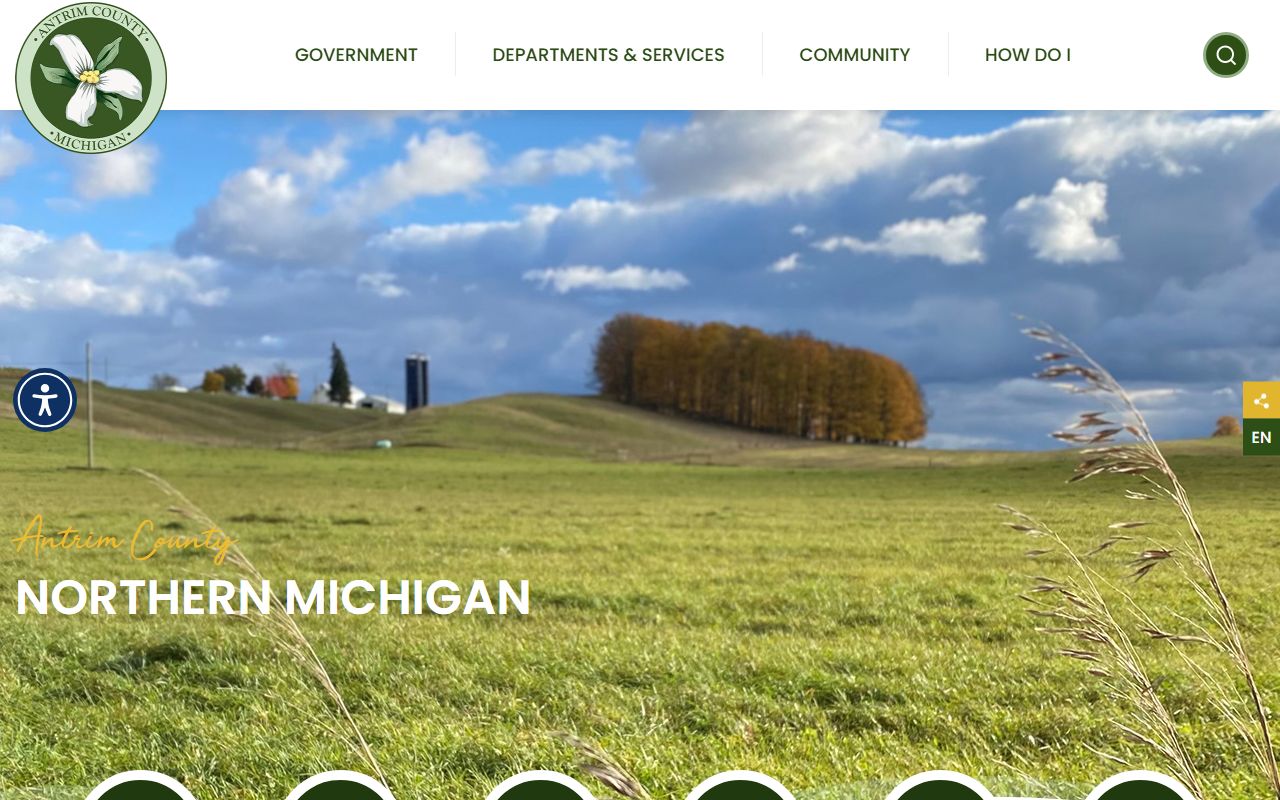
That single front door is often the fastest way to reach the office that actually holds a sheriff or custody record.
Marriage, Divorce, and Probate Records
Marriage and divorce live in different offices. The county clerk handles marriage licenses through an affidavit filed by mail or in person. Divorce files are part of the 13th Circuit civil records, so they show up in the same portal that returns other civil cases. For the license rules, fees, and copy channels, see the county's marriage and divorce records page.
Probate is its own venue. The Probate Court and Family Division, led by Judge Stacey L. Truesdell, covers estates, guardianships, conservatorships, adoptions, and name changes in the historic Bellaire courthouse. Filing steps, forms, and fees are on the probate records page. A few probate terms come up often.
- Testator
- The person who makes a will that directs how an estate is handled.
- Executor
- The person named to carry out a will, called a personal representative in Michigan.
- Conservator
- A person the court appoints to manage another adult's money and property.
- Guardian
- A person the court appoints to care for a minor or a protected adult.
Antrim County Court Records Fees
The county clerk handles most copy and search fees for circuit files and vital records. The office now takes debit and credit cards along with cash and checks, though a card surcharge applies. The circuit portals are free to browse, so fees mainly kick in when you want a paper copy or a certified record. The core rates are set out below.
| Item | Amount |
|---|---|
| Certified copy, first copy of a record | $10 |
| Certified copy, each additional copy of same record | $3 |
| Photocopy of an original record, per page | $1 |
| Records search fee | $5 |
| Typed copy from an old record | $2 |
Residents age 60 and older can get a search plus a copy, or one certified copy, for a flat $5. Card payments carry a fee of 2.99 percent, with a minimum of $3.99. Court filing fees and probate fees are set apart from these copy prices, so confirm the exact amount with the court before you pay.
Note: Certified copies carry the court seal and are the version accepted for legal use, while a plain online printout will not stand in for one.
How to Interpret Antrim County Court Records
A docket reads like shorthand at first. Each line marks an event, and each event carries a short code. Once you learn the common ones, the file starts to tell a plain story of filings, hearings, and orders. The circuit results and detail pages use a steady set of abbreviations.
- OR means an order the judge signed.
- HRG marks a hearing on the calendar.
- MO is a motion, a formal request for a ruling.
- JDG stands for a judgment, the final decision.
- FI is a felony information, a charging document.
- CB notes a bind over from district to circuit court.
Read a charge and a conviction as two different things. A charge is what the prosecutor filed. A conviction is what the court found true after a plea or a trial. A charge can be reduced, dropped, or dismissed, and the record still shows that history. The offense and sentencing table is where the outcome for each count is spelled out. The court cases page links the tools that expose those docket lines.
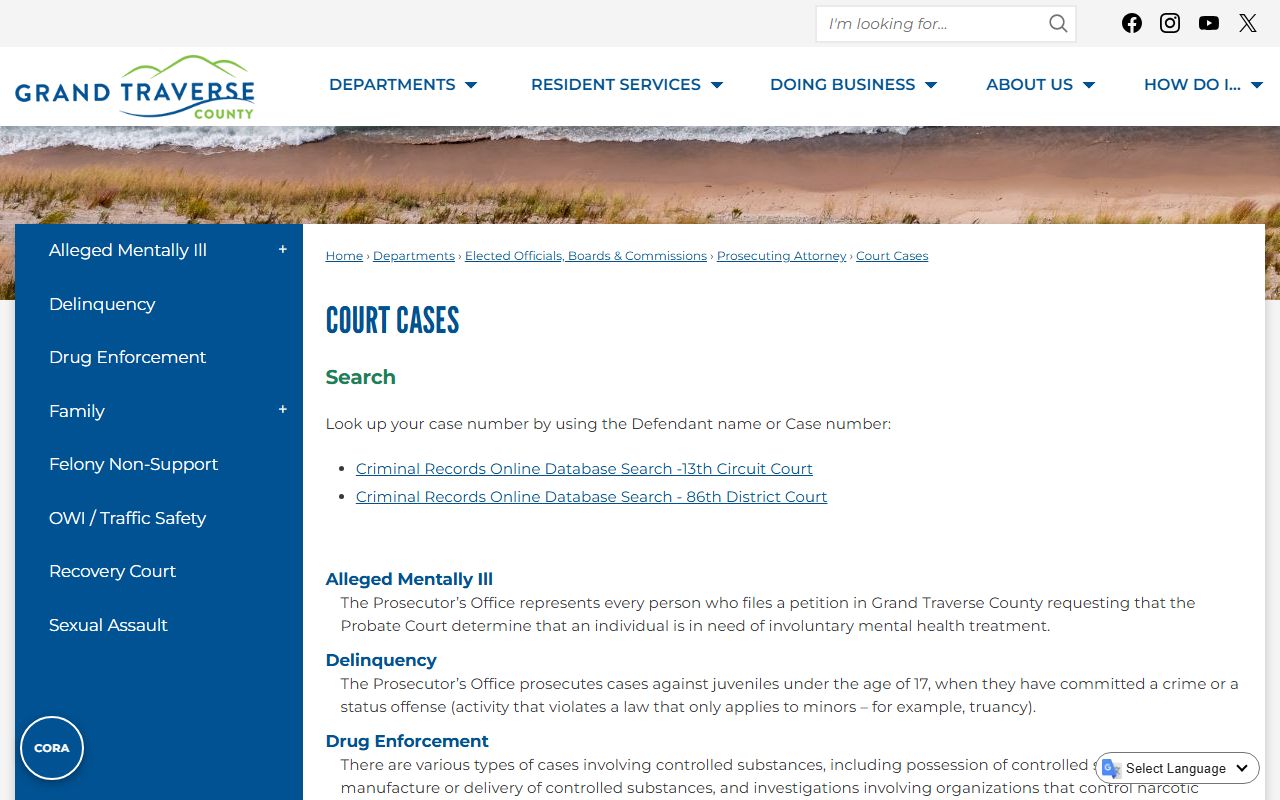
That page is a good landing spot when you know the party but not which system holds the case.
Accuracy and Record Limitations
Online files are convenient, yet they lag real life. A clerk enters an event after it happens, so a very recent hearing may not appear the same day. The public database also has date ranges, and the oldest files may only exist on microfilm or in the paper record room. A missing entry does not always mean nothing happened. It can mean the record has not been indexed online.
Note: Confirm any detail that matters, such as a disposition or a court date, with the clerk or the court records office before you rely on it.
History of Antrim County Courts
Antrim County court history is tied to Bellaire and its landmark courthouse. The county was organized in 1863, and the seat moved from Elk Rapids to Bellaire in 1879. The cornerstone of the current courthouse was laid in 1904, and the building went into use as a courthouse in 1905. A clock was added in 1922. The state named it a Michigan Historical Site in 1974, a new county building followed in 1978, and the 1905 courthouse was restored and rededicated in 1992.
The records themselves reach back further than the online tools suggest. Office records in the shared records system date to 1859. The circuit civil database carries index information from 1967 through 1985 and full case detail from 1986 to the present. The criminal database covers cases filed from 1981 to current. The old courthouse still anchors the local court system, even as several record offices now spread across Bellaire and Traverse City.
Frequently Asked Questions
How do I search Antrim County court records online?
Start on the county online services page, which links the 13th Circuit civil and criminal portals and the 86th District Court case tools. Decide first whether the case is circuit or district and civil or criminal. Then search by party name or by case number. The circuit portals cover Antrim, Grand Traverse, and Leelanau counties together, so pick Antrim from the county dropdown when the system asks for it.
Are Antrim County court records free to view?
Yes. The 13th Circuit civil and criminal search systems are free to use, and both return case lists and full detail pages at no charge. Fees only apply when you want a paper copy or a certified record from the clerk. A certified copy runs $10 for the first copy and $3 for each additional copy of the same record.
Which court holds felony records in Antrim County?
Felonies live in the 13th Circuit Court and appear in its criminal search system. Misdemeanors, traffic tickets, and civil infractions sit in the 86th District Court instead. That split matters, because a search of the circuit criminal database will not return a misdemeanor that stayed in district court.
How far back do the Antrim County court databases reach?
The circuit criminal database includes cases filed from 1981 to the present. The civil database holds index information from 1967 through 1985 and full case detail from 1986 forward. Older files that predate the online index can be viewed on microfilm or at the records office.
How do I get a certified copy of a court or vital record?
Contact the county clerk, who handles certified copies of circuit files and vital records. Requests can be mailed to the PO Box or emailed, with a copy of a photo ID and a contact phone number. Payment is by cash, check, or card. Certified copies carry the court seal and are the version accepted for legal use.
Does Antrim County post a public warrant or jail roster?
No public warrant list or jail roster was found on the county pages reviewed. The sheriff routes the public to vendor services and to a submit-a-tip form for leads. For custody detail, the inmate records page covers the fallback channels, including the sheriff phone line, VINE notifications, and a records request.