
Getting a Marriage License in Antrim County
Marriage licenses in Antrim County come from the County Clerk. The office sits in downtown Bellaire on Cayuga Street. Victoria Bishop serves as County Clerk. Her office issues the license, not the courts. A couple starts with a Marriage Affidavit. That form is filed with the clerk by mail or in person. Fax and email filing are not allowed. One or both applicants may apply. The rules split by residency, and the fee and age limits follow that split.
The county's official marriage license page lays out every rule in plain terms. It is the best starting point before anyone drives to the counter or drops an affidavit in the mail.
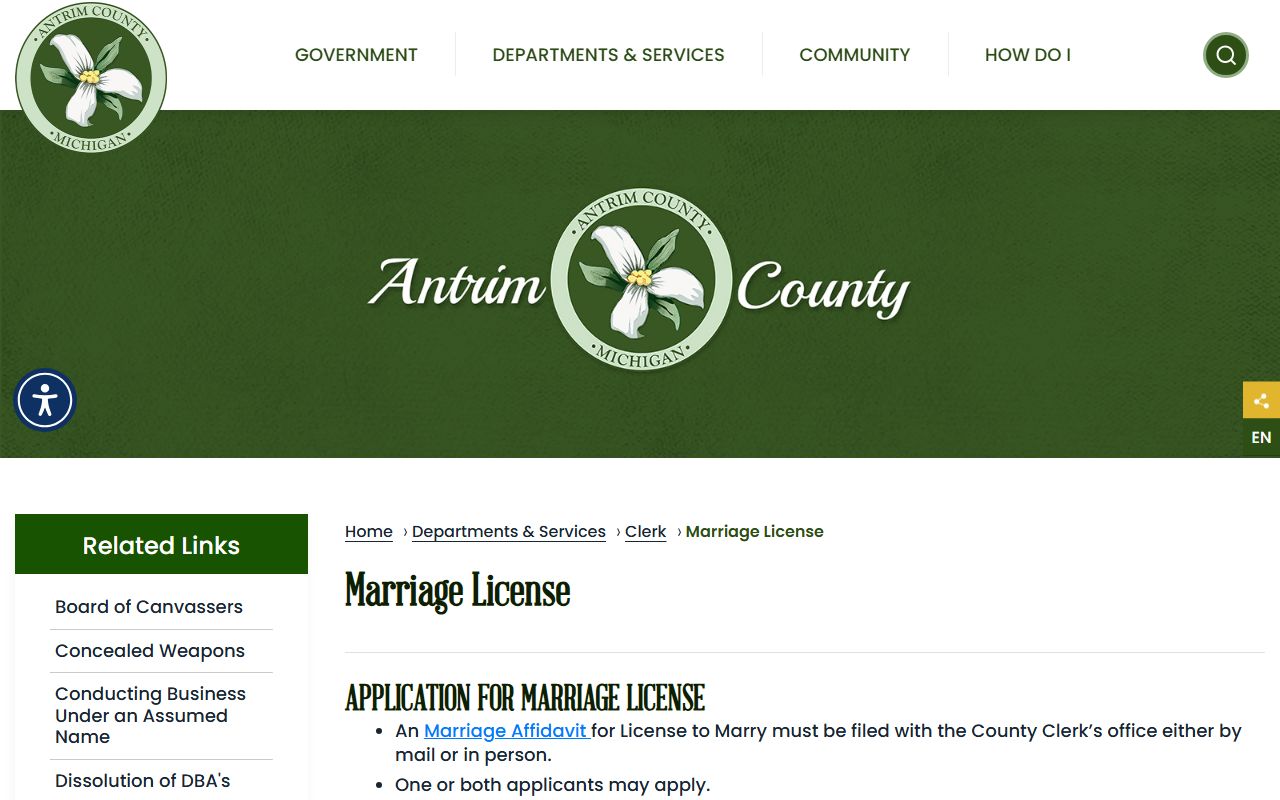
That page confirms the residency test, the age limits, and the waiting period. In-county applicants must be 18 or older. At least one of them must be an Antrim County resident for the in-county license. Out-of-state couples follow a separate track covered further down. The clerk also takes debit and credit cards for any fee.
Note: The clerk accepts the Marriage Affidavit only by mail or in person, so fax and email filings are turned away.
How to Apply for a Marriage License
The process is short once the residency path is clear. In-county couples need one Antrim County resident and both applicants at 18 or older. Out-of-state couples must both live outside Michigan, and both must be at least 16. If an out-of-state applicant is 16 or 17, a parent must consent. These steps follow the county clerk's own instructions.
- Get the Marriage Affidavit form from the County Clerk in Bellaire.
- Confirm your path: in-county with one resident applicant, or out-of-state with two non-Michigan applicants.
- Complete the affidavit, and if you plan to mail it, have your signature notarized first.
- File the affidavit with the clerk by mail to PO Box 520 or in person. Fax and email are not accepted.
- Pay the fee, which is $20 for in-county applicants and $30 for out-of-state applicants.
- Wait out the three-day waiting period, then use the license within 30 days.
Out-of-state licenses carry one extra rule. A license issued to out-of-state applicants must be used in Antrim County. That limit does not apply to in-county couples the same way.
Marriage License Application Fields
The Marriage Affidavit asks for a set of details and a few eligibility confirmations. Most of it is basic identity and residency information. The rest depends on whether the couple applies in county or from out of state. The table below lists what the clerk collects and the rule behind each item.
| Field | Required | Notes |
|---|---|---|
| Marriage Affidavit form | Yes | Filed with the clerk by mail or in person |
| Applicant name(s) | Yes | One or both applicants may apply |
| Resident status | Yes | One applicant must be an Antrim County resident for the in-county license |
| Age confirmation | Yes | 18+ in county; 16+ for out-of-state applicants |
| Parent consent | Sometimes | Required for out-of-state applicants who are 16 or 17 |
| Notarized signature | If mailed | A mailed affidavit must be notarized |
| Phone number | Yes | The clerk asks for a contact number |
| Payment | Yes | $20 in county or $30 out of state |
Finding Antrim County Divorce Records
Divorce records do not sit with the clerk's vital records desk. They live in the 13th Circuit Court civil files. The circuit court handles domestic relations for Antrim County, and its case system is public. You can look up a divorce through the 13th Circuit civil case search, which covers Antrim, Grand Traverse, and Leelanau counties at no cost.
Search by a party name or by case number. Sample divorce cases show up under case types DO and DM. Those codes mark divorce matters in the circuit system. The portal drops personal protection order cases because federal law blocks online disclosure that could reveal a petitioner's identity. Divorces stay searchable, but PPOs do not.
The circuit court page for Antrim County explains the court's role and its coverage. For older files or direct questions, the county clerk records office is the right contact. The clerk keeps the older circuit files and can point users to microfilm when a case predates the online index.
Public Access to Antrim County Marriage Records
Michigan treats most government records as open to the public. The state Freedom of Information Act sets that default. A member of the public can inspect public records unless a specific exemption applies. County vital records and circuit case files both sit inside that framework, though each office has its own request steps.
The statutory entry for Michigan's FOIA spells out the public's right to inspect. You can read the Michigan FOIA statute straight from the state legislature site.
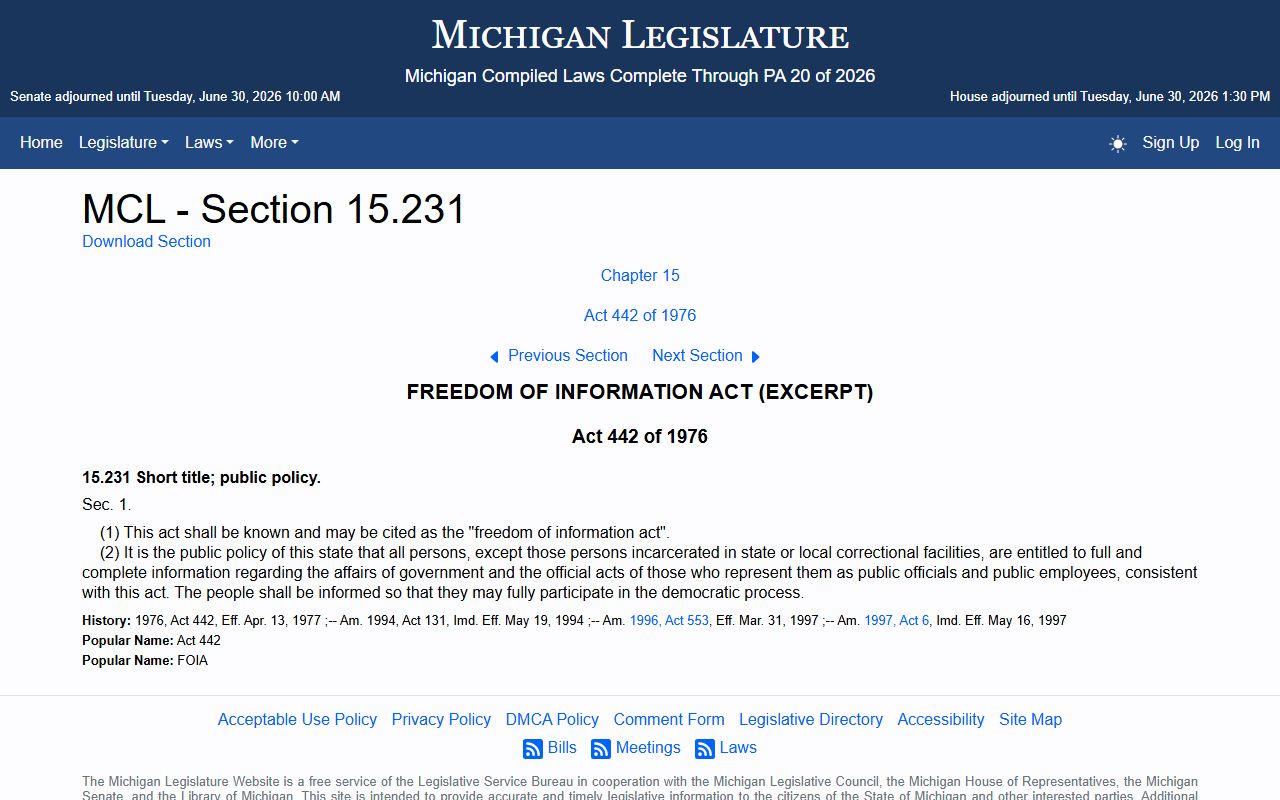
That law is why the county publishes clear request channels for its records. For marriage records, the County Clerk is the office that holds and releases certified copies. For divorce case files, the circuit records desk and the public search portal answer most first questions before a formal request is even needed.
Antrim County Marriage and Divorce Record Fees
Fees stay modest and are set by the clerk's office. The marriage license itself is the first cost, and copy fees come later if you need proof of the record. The county also gives older residents a discount. The schedule below reflects the clerk's published vital-records and marriage fees.
| Item | Amount |
|---|---|
| Marriage license, Antrim County resident | $20 |
| Marriage license, out-of-state applicants | $30 |
| Certified copy, first copy | $10 |
| Each additional certified copy of the same record | $3 |
| Typed copy from an old record | $2 |
| Photocopy of an original record | $1 per page |
| Record search fee | $5 |
| Senior 60+ search and copy | $5 |
Payment options are flexible at the clerk's office. Cash, check, and credit or debit cards are all accepted. Card payments add a processing fee of 2.99 percent, with a minimum of $3.99.
Note: Residents age 60 and older can get a search and copy, or one certified copy, for a flat $5 under the clerk's senior rate.
Ordering Certified Copies of Antrim County Marriage Records
Certified copies prove a marriage for legal and personal needs. The County Clerk issues them from county vital records. You can request one by mail to PO Box 520 or by email to clerk@antrimcountymi.gov. A written or typed request works, and the clerk asks for a phone number on it. You must include a copy of your driver's license or state ID.
The register of deeds publishes a separate fee schedule for property copies, which readers sometimes confuse with vital-record copies. You can compare the register of deeds fee schedule to see how those charges differ.
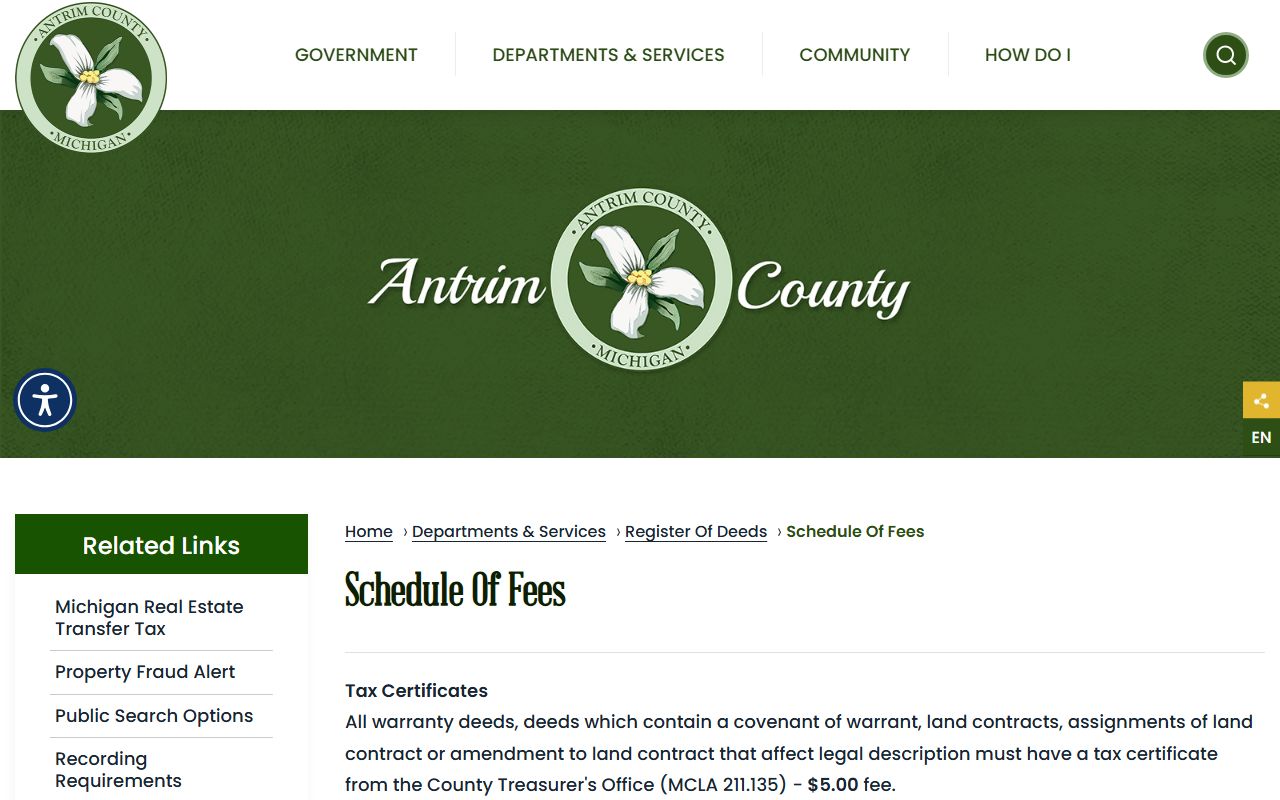
That page covers recording and property copies, not marriage certificates. Marriage and death records still run through the clerk's vital-records desk, and that is where certified marriage copies come from. The Clerk of Court page has more on the office's full record duties.
Marriage Records vs Divorce Records in Antrim County
The two records are easy to mix up, but they live apart. A marriage record is a vital record held by the clerk. A divorce record is a civil court file held by the circuit court. Each has its own request path, its own copy source, and its own search tool. The comparison below shows the split.
| Point | Marriage Records | Divorce Records |
|---|---|---|
| Office that holds it | County Clerk | 13th Circuit Court |
| Record type | Vital record and license | Civil case file, types DO and DM |
| How to search | Written request to the clerk | 13th Circuit civil case search |
| Where copies come from | Clerk vital records desk | Circuit records office |
Both records can matter in the same life event. A person who divorced and later remarries may need proof of each. The clerk handles the marriage side, and the circuit court handles the divorce decree.
FOIA Exemptions in Antrim County Divorce Records
Open records are not the same as fully open files. Michigan's FOIA carries a list of exemptions. A public body can withhold specific categories, including personal or protected details. Divorce files often hold sensitive information about children, finances, and addresses, so some parts stay shielded even when the case is public.
The exemptions section of the state law sets out what can be withheld. The Michigan FOIA exemptions page lists the protected categories in detail.
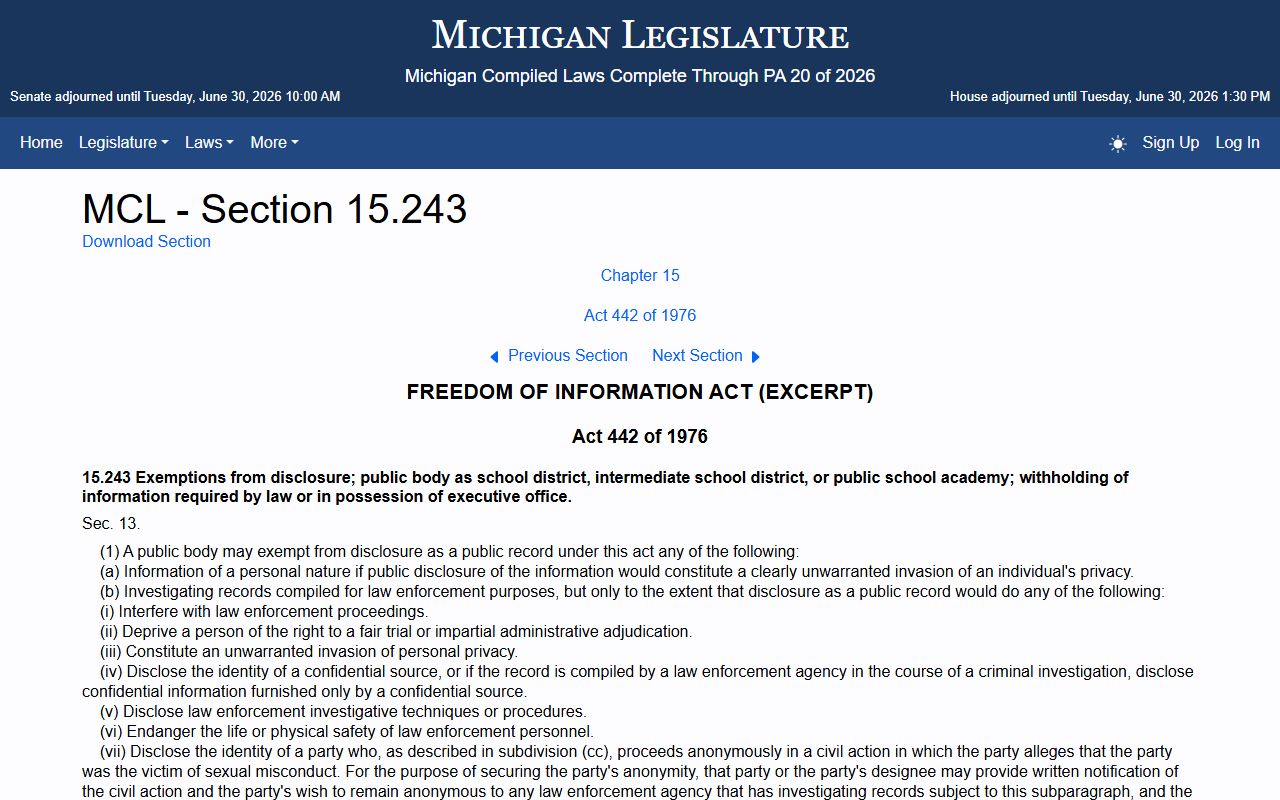
Court rules add another layer of protection on top of FOIA. Birth dates, Social Security numbers, driver's license numbers, and financial account numbers are redacted from public court files. The case may stay visible while a sensitive attachment is sealed by court order.
Note: Divorce cases stay public in the circuit system, but personal identifiers inside the file are redacted and personal protection orders are removed entirely.
Michigan Court Rules for Divorce Case Files
Court records follow their own access rules, separate from the vital-records desk. Michigan's court records management rule governs what is open, what is redacted, and what stays offline. A divorce case can be public at the courthouse while some images and data do not appear online. That is normal for family files.
A typical divorce case detail page in the circuit system shows a clear set of fields. These give a reader the arc of the case from filing to judgment.
- Case number and case type, such as DO for divorce with no children
- County and assigned judge
- Date issued and date closed
- Disposition and disposition date
- Litigants, attorneys, and the court proceedings log
The state's records management page explains those access limits. For the broader picture of what any Antrim County file contains, the court records overview walks through the same field groups.
Michigan Public Records Law and Record Access
All of these request paths rest on one statute. Michigan's Freedom of Information Act, passed in 1976, is the public-records law behind county and court access. It sets the right to inspect, the request steps, and the fee limits that offices must follow. Every clerk and court record channel in the county traces back to it.
Readers who want the full act can review the landing page for the law itself. The Michigan FOIA act page gathers the statute in one place.
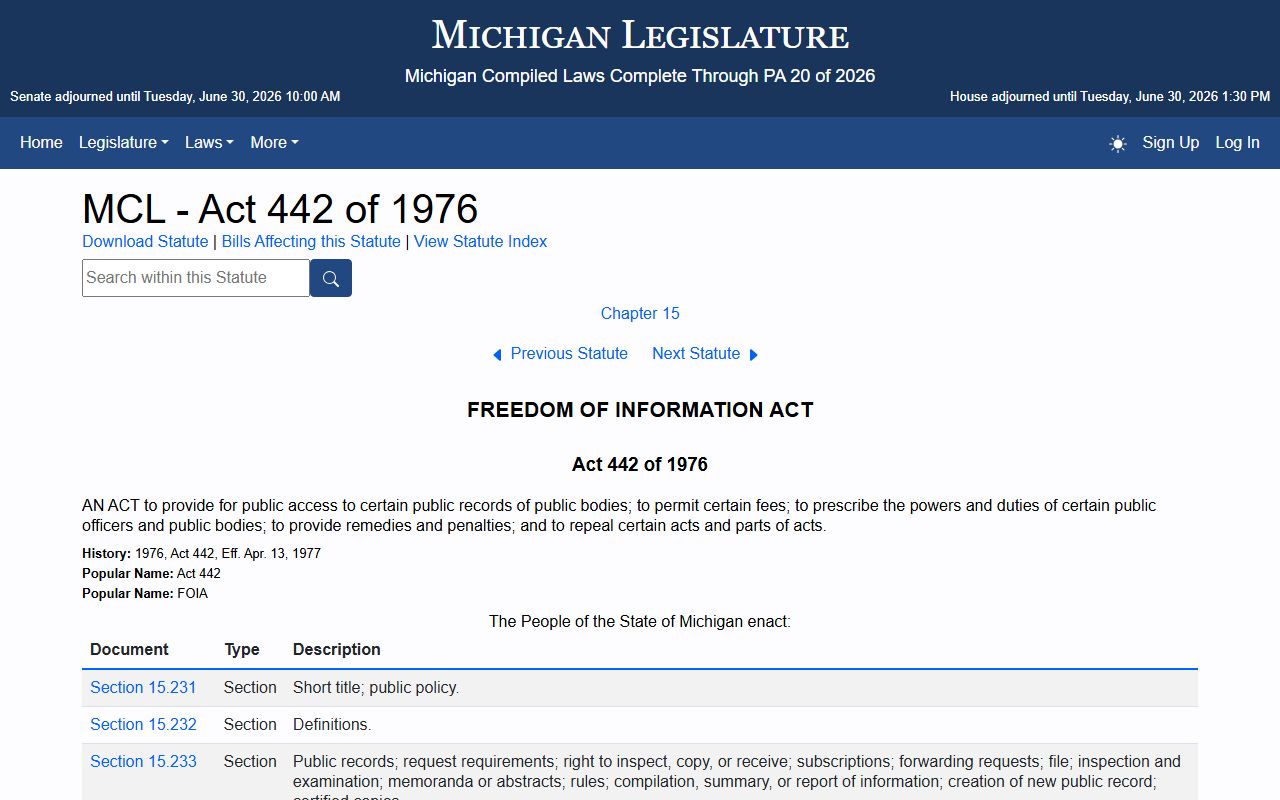
For most people, the practical takeaway is simple. Start with the office that holds the record. The clerk handles marriage records, and the circuit court handles divorce files. The statute stands behind both, but the local desk answers the request.
Antrim County Vital Records Fallback
Statewide copies exist as well. The Michigan Department of Health and Human Services keeps vital records for the whole state through its vital records program. For Antrim County marriage records, though, the local County Clerk stays the direct source. The clerk issues certified copies, runs searches, and answers record questions for county files. Divorce decrees remain with the circuit court that entered them.
When a record predates the online index, the clerk's office is still the first call. The contact card below is the county's vital-records desk for marriage certificates and related requests.
Antrim County Clerk, Vital Records
203 E Cayuga St
PO Box 520
Bellaire, MI 49615
231-533-6353