
Criminal Court Records in Antrim County
A criminal court record is the official case file a court opens the moment a person is formally charged with a crime. The county clerk keeps it, updates it, and stores it as a public record. It holds every filing tied to that case. Charges, the arraignment, motions, hearings, the plea or verdict, and the final sentence all land in the same file. The record grows as the case moves forward. By the time a case closes, the file tells the full story from first charge to last order. In Antrim County the clerk is clerk of the criminal division of the circuit court, which makes that office the keeper of these felony files.
Two trial courts handle criminal matters here. The 13th Circuit Court hears felonies, the serious crimes that can carry more than a year behind bars. The 86th District Court handles misdemeanors, traffic offenses, and civil infractions. Both courts serve Antrim, Grand Traverse, and Leelanau counties as a shared tri-county bench. Felony case files sit in the circuit court system, and the searchable circuit database reaches back to 1981. Misdemeanor and traffic files stay with the district court. These criminal files are one slice of the wider set of Antrim County court records, so the first task is deciding which court holds the case.
How to Search Antrim County Criminal Court Records
Felony cases are searched through the 13th Circuit criminal records portal, a free public tool that covers the tri-county circuit. A search runs on a defendant name or a case number. When you use a case number, the form asks you to pick a county from a dropdown. A partial last name works as long as the first name field stays blank. The result list returns the defendant name, case number, case type, the district court case number, and the county.
- Open the 13th Circuit criminal records search.
- Enter the defendant's last name, or switch to the case year and case number path.
- Pick Antrim from the county dropdown when the case-number path asks for it.
- Submit the query and review the returned list of defendants and case numbers.
- Open a case to read the docket, disposition, and sentence, then request a certified copy from the county clerk if you need one.
Misdemeanor and traffic cases route through the 86th District Court, reached from the county court-cases page. Older felony files that predate the online index can be viewed on microfilm at the records office. For a statewide criminal history, Michigan maintains identification records under a separate state system rather than the county portal.
Note: The circuit criminal database includes felony cases filed from 1981 to the present, so anything older may only survive on microfilm at the records office.
Stages of an Antrim County Criminal Case
Every criminal case follows a set path, and each step leaves a mark in the file. It starts when the county prosecutor files a charging document, most often a complaint. The current prosecutor, Wilson Brott, brings and prosecutes charges from an office in downtown Bellaire and is central to plea talks and victim contact. The defendant is then arraigned, which is the first court appearance where the charge is read and a plea is entered. Pretrial hearings and motions come next, when both sides trade filings and the judge rules on legal questions. In felony cases, a district court judge may bind the matter over to circuit court, and the prosecutor then files a felony information.
Case flow: Charges Filed › Arraignment › Pretrial and Motions › Plea or Trial › Disposition › Sentencing
Most cases close with a plea rather than a trial. The disposition records how each count ended, whether by guilty plea, conviction at trial, dismissal, or acquittal. Sentencing follows a conviction, and the file lists the punishment the judge imposed. The docket, a running log of dated events, ties the whole sequence together. Reading it in order shows when each step happened and who took part. That is why a full criminal court record is more useful than a single charge line pulled out of context.
What an Antrim County Criminal Court Record Shows
The circuit criminal detail page lays out a case in labeled fields. It splits into two useful halves. One half names the people and dates in the case. The other half is an offense and sentencing table that shows what happened to each charge. Together they answer the two questions searchers ask most: what was the charge, and what did the court do with it. The fields below appear on a standard felony record.
| Field | What It Shows |
|---|---|
| Case Number | The court's file number, such as 2015-1877 FC, with letters that flag the case type. |
| County | The tri-county location where the case was filed, Antrim, Grand Traverse, or Leelanau. |
| Case Type | The class of charge, for example Felony/Capital or Felony/Non-Capital. |
| Case Status | Whether the case is open or closed. |
| Defendant | The name of the person charged. |
| Birthdate | The defendant's date of birth, used to sort common names. |
| Arraigned On | The date of the first appearance and plea. |
| Judge | The judge assigned to the case. |
| Offense Date | The date the alleged crime took place. |
| Complaint # | The number on the charging complaint. |
| Arresting Agency | The police or sheriff agency that made the arrest. |
| Defense Attorney | The lawyer representing the defendant. |
| Prosecutor | The attorney prosecuting the case for the county. |
| State ID # / CTN # | State identification and tracking numbers that link to a criminal history. |
| Fingerprinted? | A yes or no flag on whether prints were taken. |
Note: Court rules require personal identifiers such as birth dates and Social Security numbers to be redacted, so a public record can show a case yet hide those private lines.
Reading Dispositions and Sentences
The disposition is the end result of a charge, and the sentence is the punishment that follows a conviction. On the detail page an offense and sentencing table lists each count with its plea, its conviction result, the offense statute, a short description, and the degree of the crime. The court proceedings log sits beside it and carries codes such as JDG for judgment, FI for a felony information, and CB for a bind over. Read the count first, then the plea, then the conviction column, and the story of each charge becomes clear.
A single case can hold several counts, and they do not all end the same way. One count may end in a guilty plea while another is dismissed. The most common outcomes a reader will see are short and easy to sort.
- Guilty plea entered by the defendant
- Conviction reached at trial
- Not guilty verdict, also called an acquittal
- Dismissed by the court or the prosecutor
- No contest, where the defendant does not admit guilt but accepts the outcome
After a conviction, some people later ask the court to set the record aside. Michigan spells out that relief in its set-aside statute, and the state posts the full text on the Michigan Legislature page for MCL 780.621c.
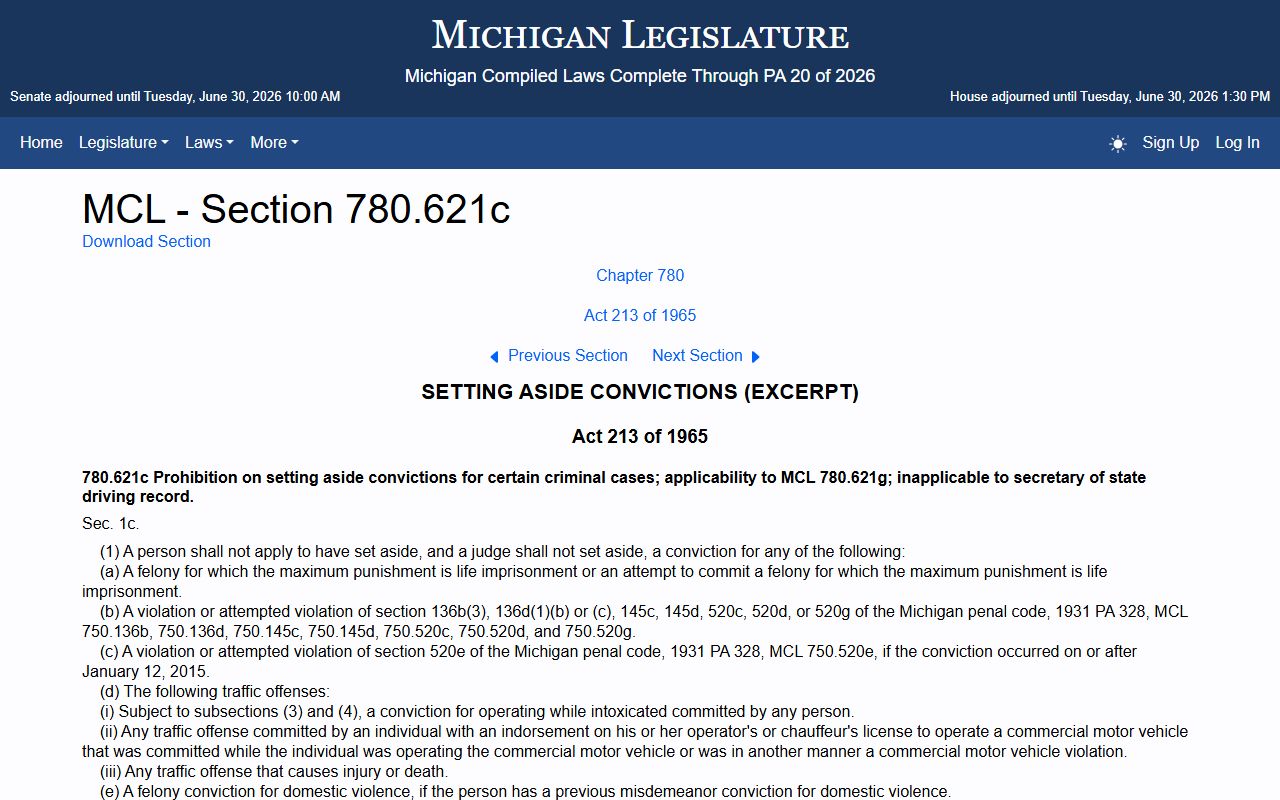
That statute governs when a court may grant relief for certain convictions, which changes how a disposition reads years later. A set-aside does not rewrite the original disposition, but it does alter public access to it at the source.
Charges vs. Convictions
Being charged is not the same as being convicted. A charge is an accusation the prosecutor files. A conviction is a finding of guilt, either by plea or by verdict. A criminal court record can show charges that were later dropped, dismissed, or ended in acquittal, and those charges still appear in the file. A closer look at how charges are filed and changed lives in the Antrim County court charge records.
| Charge | Conviction | |
|---|---|---|
| Stage | Accusation by the prosecutor | Verdict or plea of guilt |
| Burden of Proof | Probable cause | Beyond a reasonable doubt |
| Can It Change | Amended, reduced, or dropped | Stands unless appealed or set aside |
| Public Record | Yes | Yes |
Public Access to Criminal Court Records
Michigan treats court files as open records, but the rules set the limits. Court rules define what counts as a court record, how filings are handled, and which personal identifiers must be masked. Access rules also say that some documents, images, and data are not posted online even when the case itself is public. So a searcher can usually see the case and the docket while a sealed attachment or a private identifier stays out of view.
Key Statutes:
Michigan Court Rule 1.109 - defines a court record and requires protected personal data to be redacted from filings.
Michigan Court Rule 8.119 - makes court records public to the extent the rule allows while keeping some documents and data off the open web.
Criminal history data carries its own rules beyond the case file itself. Michigan spells out how that identification data is kept and shared, and the state posts the law on the Michigan Legislature page for MCL 28.241.
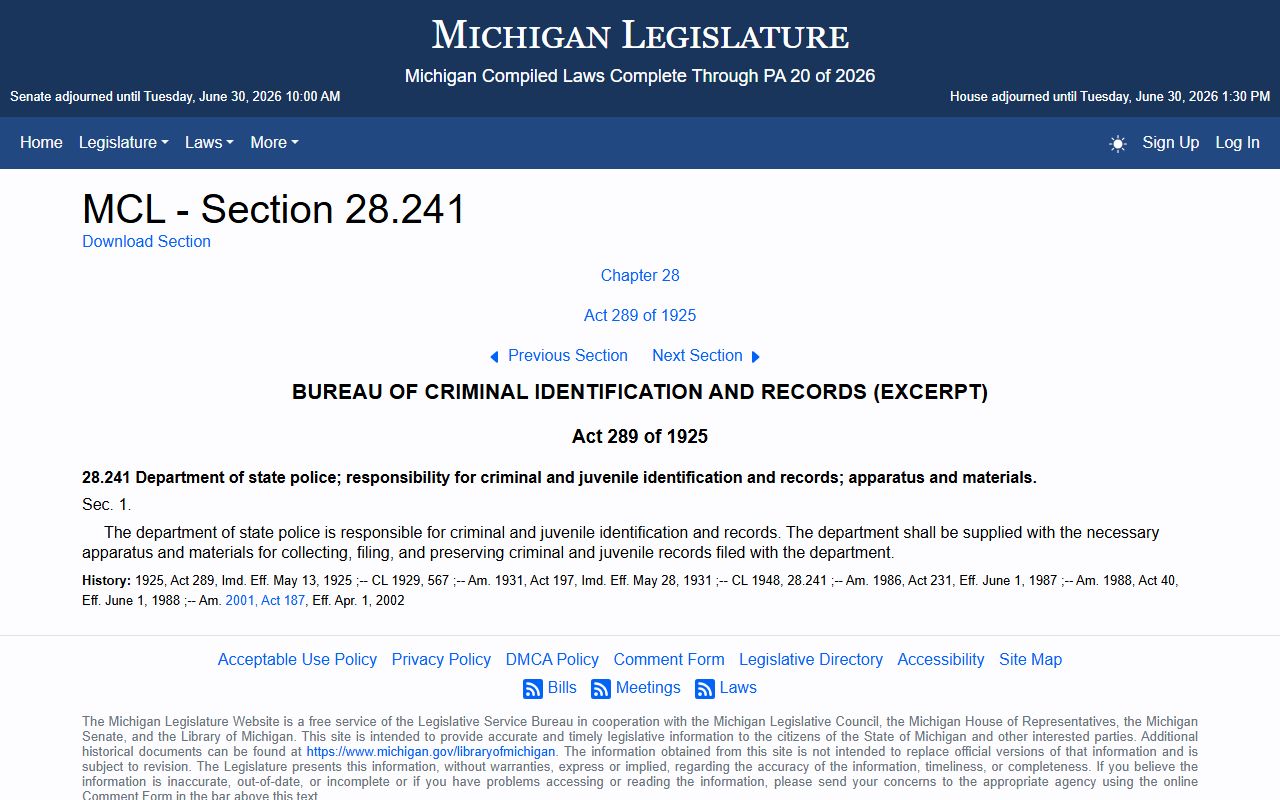
That statute covers the state repository of criminal identification records, which is separate from any single Antrim County case file. It explains why a courthouse search and a statewide history search can return different results for the same person.
Sealed vs. Expunged Records in Antrim County
Sealing and expunging both hide a record, but they are not the same tool. A sealed record still exists and stays on file, yet the public cannot see it without a court order. An expunged conviction is set aside under state law, so it is treated as though it never happened for most public purposes. Eligibility for each depends on the charge, the outcome, and how much time has passed. The petition process runs through the court that handled the case.
| Sealed | Expunged | |
|---|---|---|
| Visibility | Hidden from public view by order | Set aside and treated as never existed |
| Law Enforcement | Limited access remains | Very limited access remains |
| How It Happens | Court order in the case | Petition under the expungement statutes |
| Eligibility | Set by the type of case and court order | Set by charge, waiting period, and conviction count |
The main Michigan expungement law is the anchor for setting aside an eligible conviction. The state publishes the full text on the Michigan Legislature page for MCL 780.621.
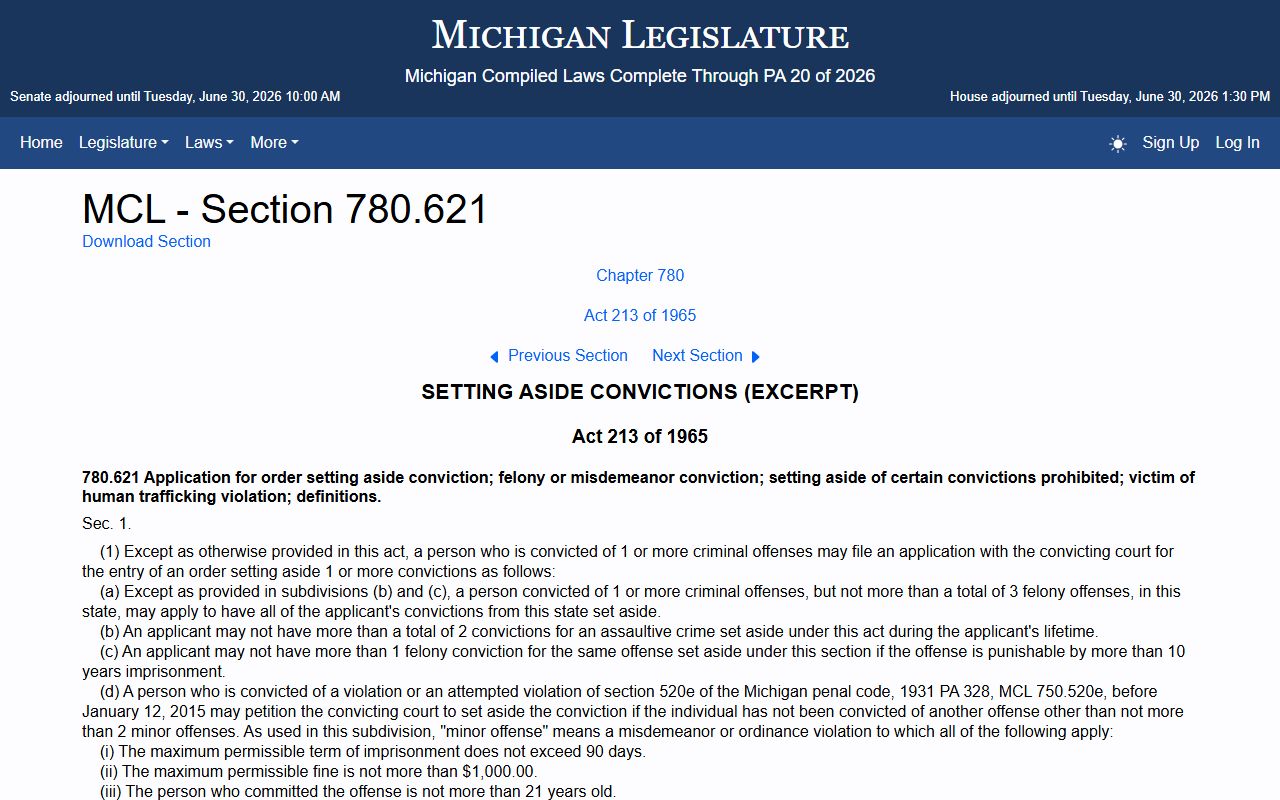
That statute is the starting point for anyone weighing whether a conviction can be cleared. Timing is its own hurdle, because the law sets waiting periods before a petition can be filed.
The state lays out those timing and eligibility rules in a companion section, posted on the Michigan Legislature page for MCL 780.621d.
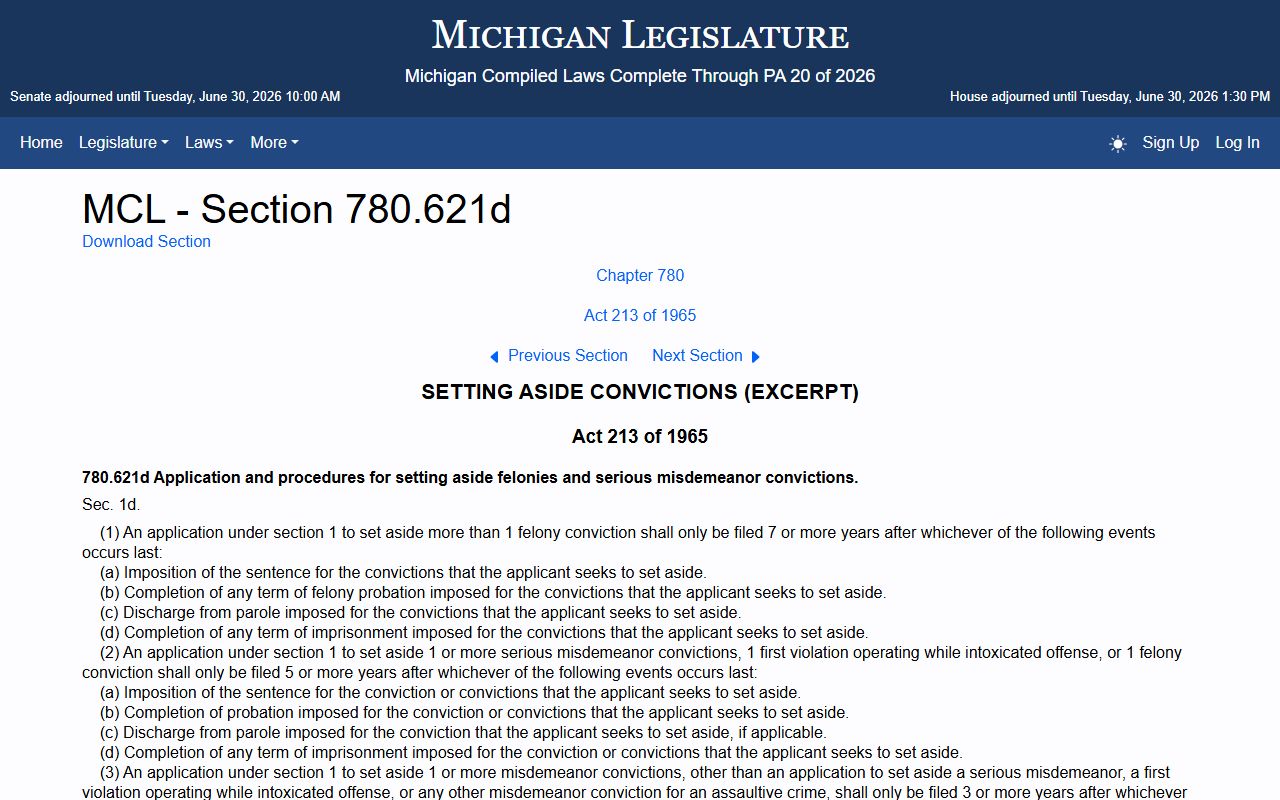
Reading the timing rule first saves wasted filings, since a petition brought too early can be denied. Once the waiting period is met and the court grants relief, public access to the record changes at the source.
Note: An expunged conviction is not treated the same as an open public conviction, so a case that once appeared in a search may drop out of public view after relief is granted.
Background Check Considerations
A casual name search on the circuit portal is not a formal background check. Employers, landlords, and licensing bodies that screen people must follow federal rules for consumer reports. Those reports come from regulated agencies that verify identity and follow dispute procedures. A free case lookup can miss sealed matters, mix up common names, or lag behind a recent court order. For any decision with legal weight, the certified court file from the clerk is the record that counts.
Important: This site is not a consumer reporting agency under the Fair Credit Reporting Act, and its records may not be used for employment, credit, tenant, or insurance screening.
Restricted Antrim County Criminal Court Records
Not every criminal matter is open to the public. Juvenile cases are largely closed, since the law shields records of minors in delinquency and protective proceedings. Sealed documents stay hidden by court order. Personal protection order cases were pulled from the online civil portal because federal law blocks disclosure that could reveal a petitioner's identity or location. Even in open files, private identifiers are masked. The result is a mix of what a searcher can and cannot see.
- Juvenile delinquency and protective proceedings
- Adoption and some mental health matters
- Sealed documents held under court order
- Expunged convictions set aside by petition
- Redacted birth dates, Social Security numbers, and account numbers
Juvenile confidentiality has its own statute that keeps most youth records out of public view. The state publishes it on the Michigan Legislature page for MCL 712A.28.
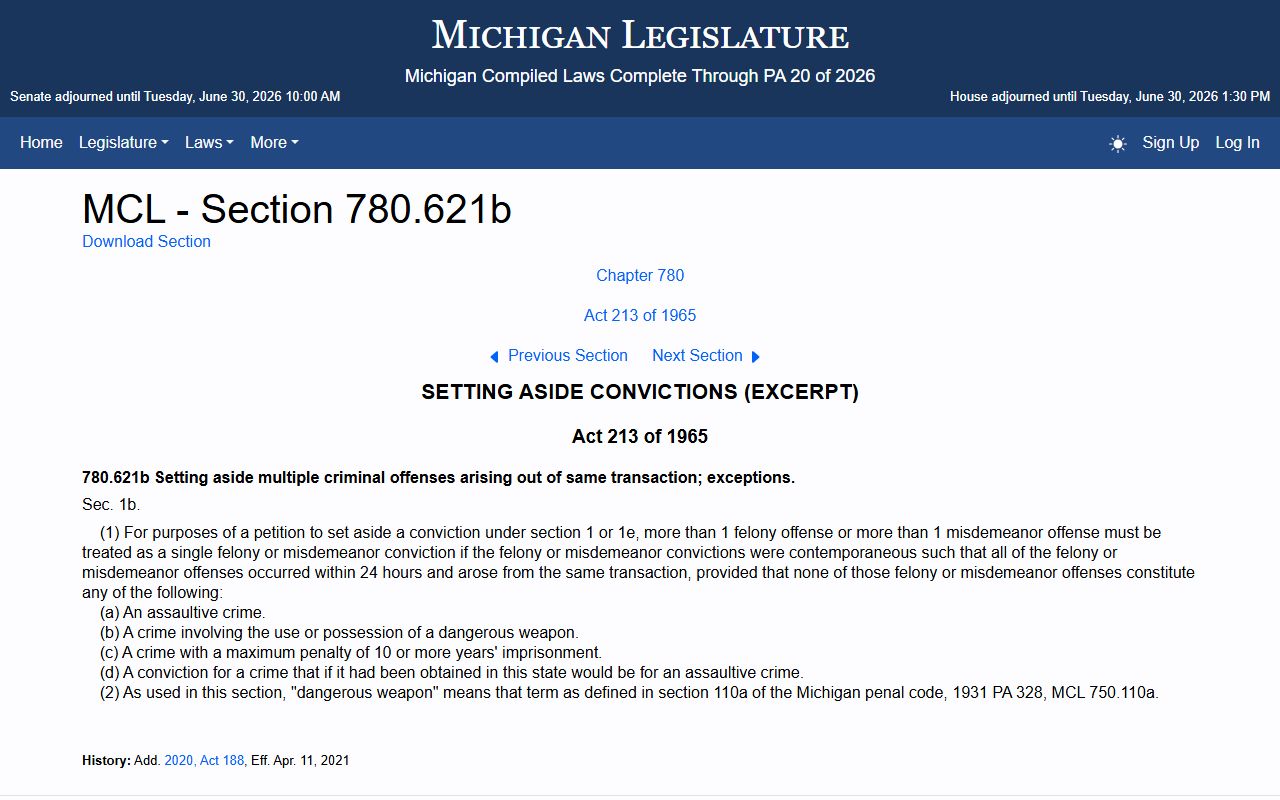
Michigan also gives special set-aside treatment to certain marijuana convictions, shown on the Michigan Legislature page for MCL 780.621b. That law can move an old conviction out of public reach even when a person never files a petition.
Fingerprints tie a person to a criminal history, and the state runs part of the expungement process through electronic prints. The rule appears on the Michigan Legislature page for MCL 780.621g.
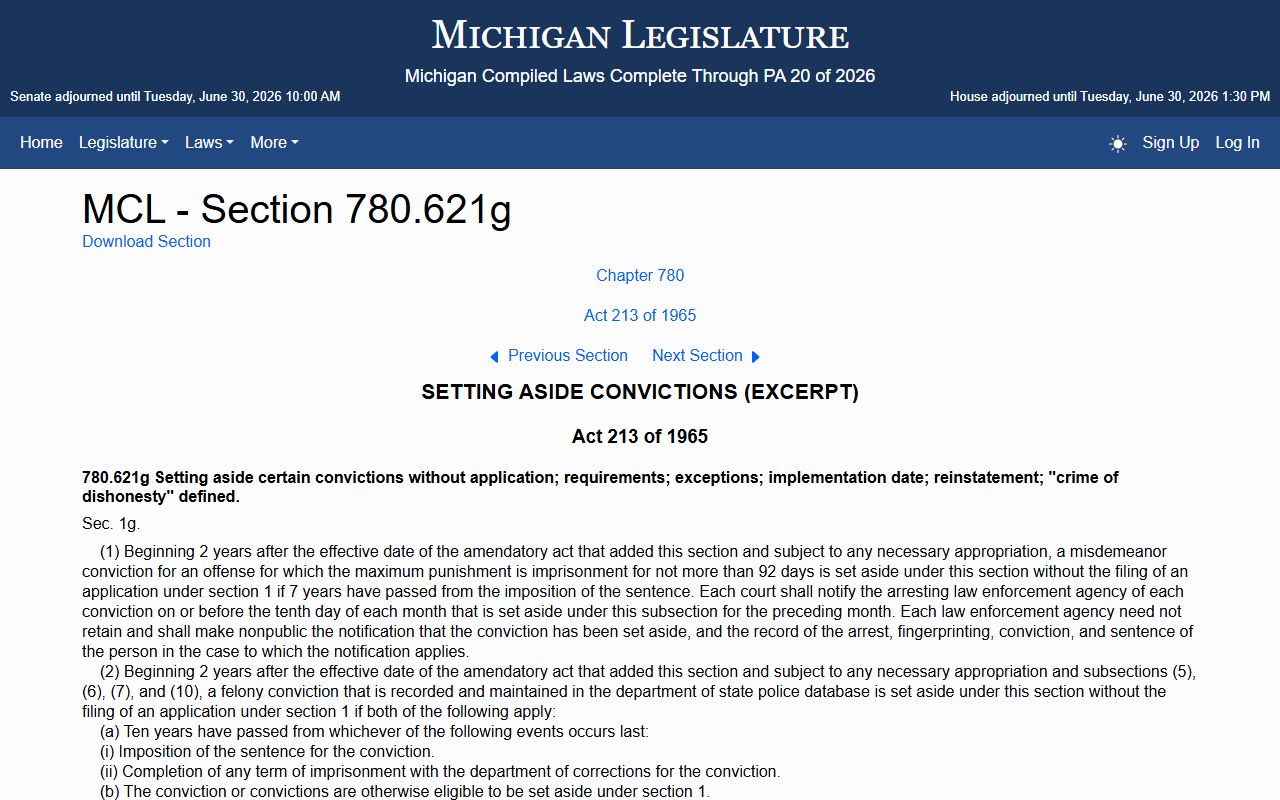
That fingerprint step is how the state confirms which records qualify for relief before a court acts. It shows why the paper case file and the state history system have to stay in sync.
Note: When a record is sealed, expunged, or juvenile, the county clerk cannot hand it to the public, and the correct path is a court petition rather than a records request.