
What Probate Covers in Antrim County
Probate is the branch of the court that handles wills, estates, and the legal care of people who cannot fully manage their own affairs. In Antrim County the Probate Court and Family Division carries this work. It reviews the estates of people who have died, appoints guardians and conservators, and hears adoptions and other family petitions. The county lists the exact subjects it handles right on its probate page. That list is a good map of what an Antrim County probate record can involve.
The court hears a set range of matters. Each one opens a case file that becomes an Antrim County probate record.
- Adoption and emancipation of a minor
- Guardianship of an adult, a minor, or a developmentally disabled adult
- Conservatorship of an adult or a minor
- Informal probate estate and small estate under $50,000
- Name change petitions
One court hears all of it. That single structure keeps probate and family matters in Bellaire rather than spread across separate buildings. Because Antrim County pairs probate with the family division, many household legal needs run through the same clerks and the same historic courthouse.
Probate Terms Defined
Probate filings use words that rarely come up anywhere else. A short glossary helps before reading a file or filling out a form. These terms appear across Antrim County probate records and the state forms the court accepts.
- Testator
- The person who made the will.
- Executor
- The person named in a will to carry out its terms.
- Personal representative
- The Michigan term for the person who settles an estate, whether named in a will or appointed by the court.
- Intestate
- Dying without a valid will, which sends the estate to state distribution rules.
- Guardianship
- A court order giving one person authority over the personal care of a minor or an adult who cannot decide for themselves.
- Conservatorship
- A court order placing another person's money and property under a manager's control.
- Conservator
- The person the court names to handle those finances.
Guardianship and conservatorship often get confused. One covers the person, the other covers the money. The court can grant both to the same individual or split them between two people.
How to Search Antrim County Probate Records
Antrim County does not post a full probate case viewer in static web pages. Instead it runs a public document center where the court's own forms and public documents are searchable. The court's probate and family division page anchors the whole process, from the document center to the payment notes and the current docket.
The document center lets a person look for a file by name and reset the search to start over. Categories are sorted by sequence, and documents within each category are ordered by record ID. Sample items include the Application to Set Aside Adjudication, a Financial Form, a Request for Records, and links to Michigan approved court forms.
The county's probate and family division landing page is the anchor for court hours, payment rules, and the current docket. A quick look there sets up any deeper search.
The Probate Court and Family Division page gives the office details a searcher needs first.
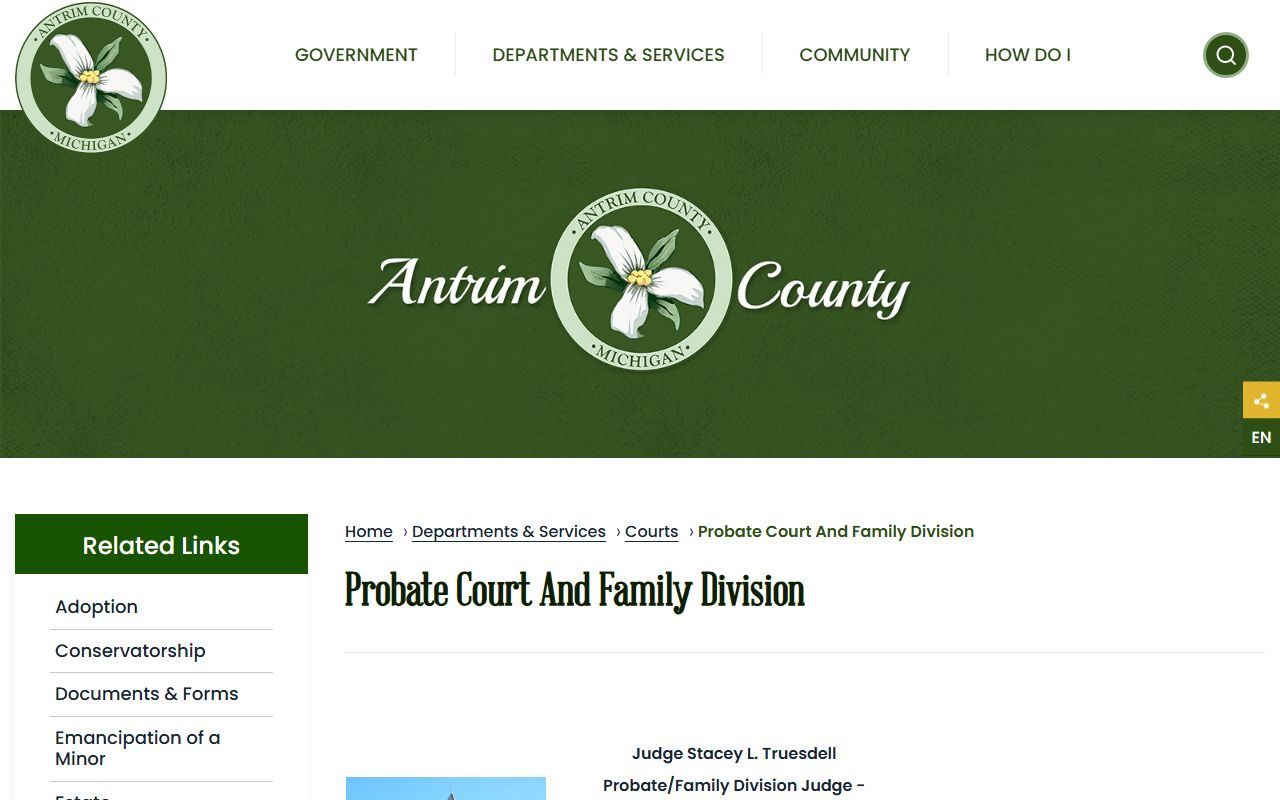
That page confirms the judge, the office hours, and the payment options before a person ever files. To reach the actual forms, the document center is the next stop.
- Open the probate document center from the court page and read the category list.
- Type a file name into the search box, or browse a category in sequence order.
- Select the form or public document, then download the PDF or note the record ID for a records request.
The probate documents and forms center holds the searchable file list.
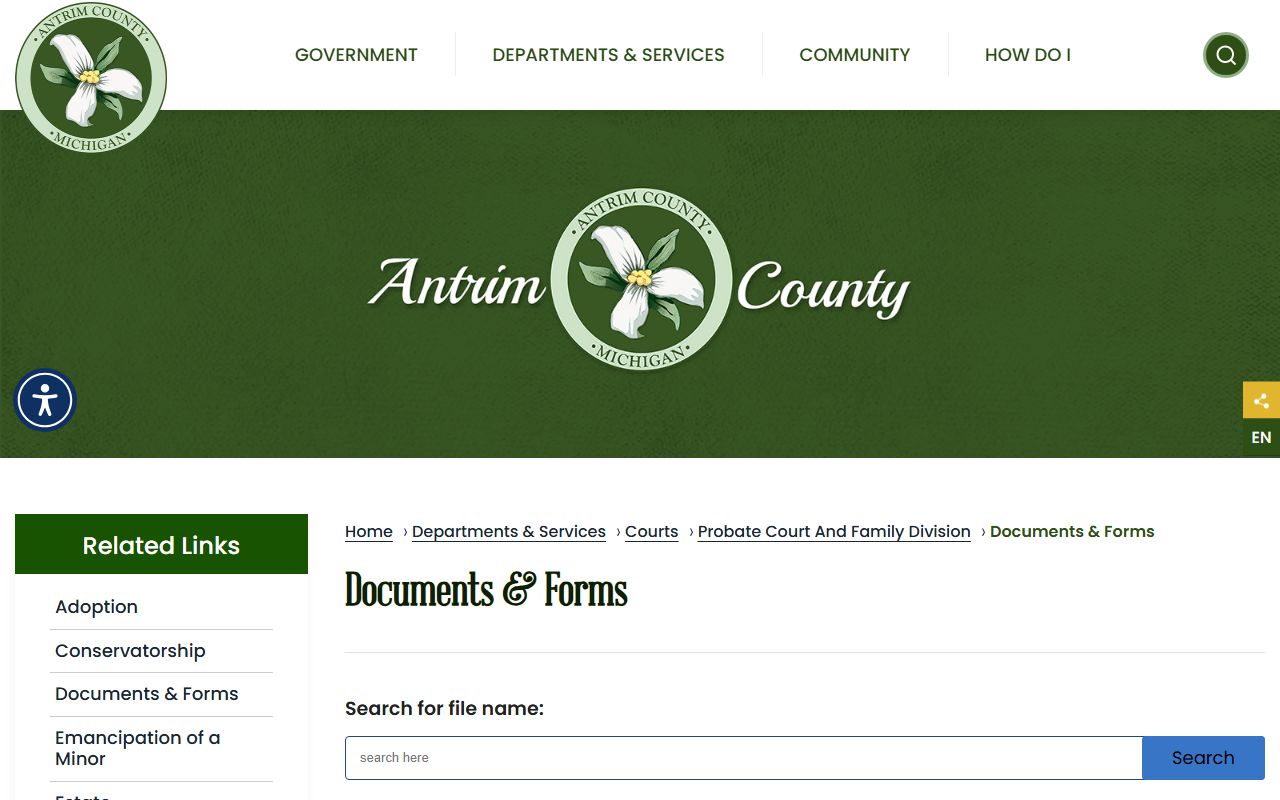
The document center returns forms and public filings, not sealed case detail. For a specific estate or guardianship file that is not posted, a records request to the court is the correct route.
Note: The document center holds forms and public documents, so a full estate case file may still require a direct request to the Antrim County Probate Court.
Antrim County Probate Court Contact
The Antrim County Probate Court and Family Division sits in the historic courthouse in downtown Bellaire. Judge Stacey L. Truesdell presides. The office keeps a daily lunch closure, so timing a visit around that window matters.
Antrim County Probate Court and Family Division
205 E Cayuga St
PO Box 130
Bellaire, MI 49615
231-533-6681
Fax: 231-533-6600
probatecourt@antrimcountymi.gov
Hours: 8:30 a.m. to 4:30 p.m., closed daily 12:00 p.m. to 12:30 p.m.
Payment for probate work has clear limits. Credit card payment runs through GovPayNow, and it is available only for probate filing fees, not for other services. A person must already have an open probate case, and the court has to confirm the exact fee before the transaction. A convenience fee applies to every card payment.
Two other channels exist for anyone who prefers not to pay by card. Mailed payments go to the probate court at PO Box 130 in Bellaire. There is also a secure drop box outside the county building's southeast entrance off M-88, which lets residents drop documents without waiting for the counter to open.
Note: GovPayNow accepts card payments only for probate filing fees on an open case, and the court must confirm the amount before any convenience fee is added.
Antrim County Probate Filing Fees
Probate fees in Antrim County depend on the type of petition. The county posts the name change filing fee directly, and it sets the dollar line that separates a small estate from a full one. Card payments add a convenience fee through GovPayNow, so the amount collected can run a little above the base fee.
| Item | Amount |
|---|---|
| Name change petition filing fee | $187 |
| Small estate threshold | Under $50,000 |
| Credit card payment (GovPayNow) | Filing fee plus convenience fee |
| Mailed or drop-box payment | Filing fee as confirmed by the court |
The small estate line is not a fee. It is a threshold. When an estate falls under $50,000, Michigan allows a simpler process than a full formal probate, which can lower cost and time for the family. For any exact figure on a guardianship or estate petition, the court confirms the amount before payment.
Estates, Guardianships, and Conservatorships in Antrim County
Most Antrim County probate records fall into three groups. There are estates, which settle what a person left behind. There are guardianships, which protect a person's care. And there are conservatorships, which protect a person's money. Each has its own petition, and each opens its own file at the court.
Estate cases split by size and formality. A small estate under $50,000 uses a lighter path, while a larger estate may run through informal probate with a personal representative. Guardianship reaches minors, adults, and developmentally disabled adults, and each type carries its own required documents and its own filing fee.
The guardianship of a minor page lays out the filing fee and the paperwork a petitioner must bring.
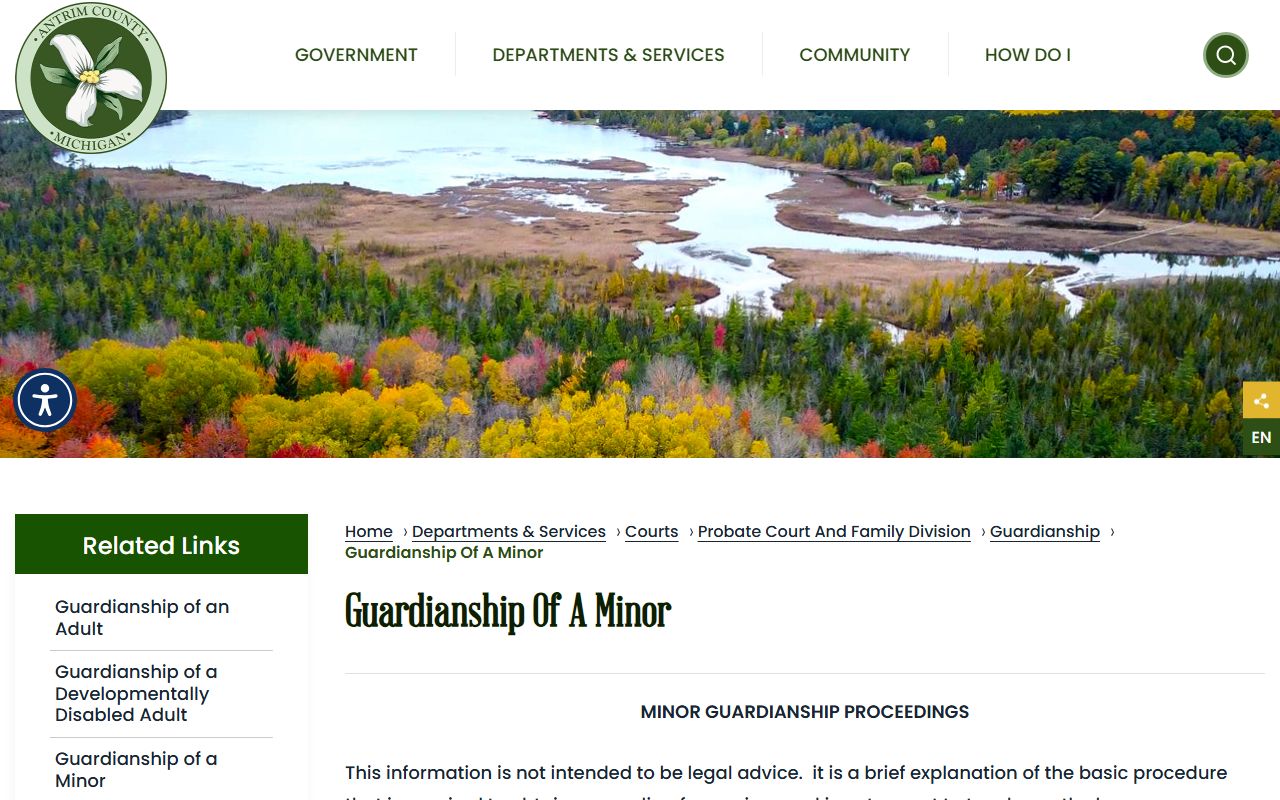
That guardianship page shows how detailed a single petition can be, from the fee to the supporting proof the court expects. Conservatorship of an adult or a minor follows the same court but centers on control of assets rather than daily care.
Antrim County Name Change Petitions
Name changes run through the probate court, and Antrim County spells out the rules. A petitioner must have lived in the county for at least one year. The Petition to Change Name has to be completely filled out and signed in black or blue ink. A copy of the birth certificate goes with it, and the filing fee is $187.
The criminal-history rules are strict. The petitioner must disclose any criminal record, including pending charges, or state clearly that none exists. The court may check that disclosure through LEIN or ICHAT. Notice of the hearing may need to run in the local paper, and the affidavit of publication must be filed before the hearing date. Once the judge signs, the court issues a certified copy of the order.
The name change petition page lists every required form and the residency rule in full.
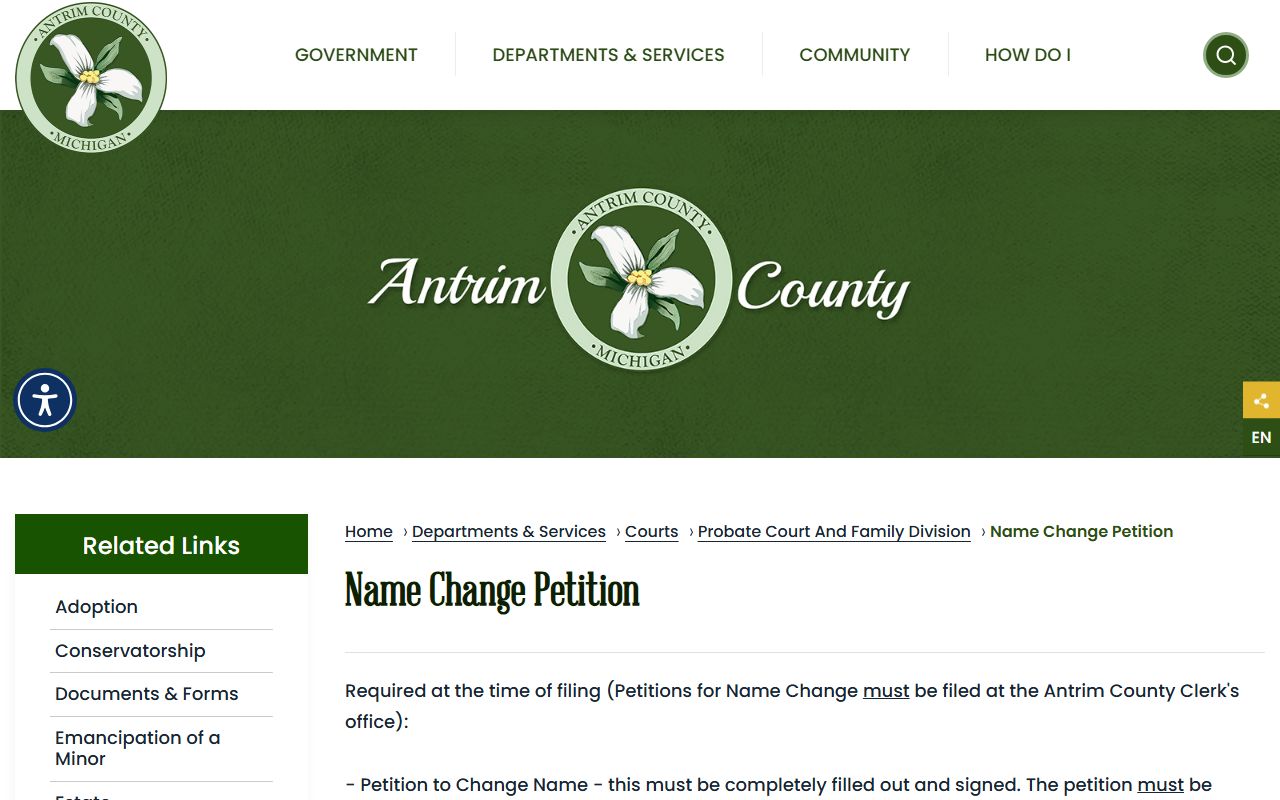
The name change page also links a set of state forms, including the Protected Personal Identifying Information form and a request for nonpublic and confidential record treatment. Those forms show how privacy is built into an ordinary Antrim County probate filing.
Note: A name change petition in Antrim County requires one year of county residency, a birth certificate copy, full criminal-record disclosure, and the $187 filing fee before a hearing is set.
Sample Antrim County Probate Docket
The court publishes a combined docket for its two roles. It is titled the Family Court and Probate Court Docket, and it covers a set date range rather than a single day. The listing appears as a linked PDF on the court home page.
A recent example ran for June 29, 2026 through July 2, 2026. That range format lets a visitor see the week's scheduled probate and family matters in one file. It is the visible public sample for the probate side, even though the county page does not expose a full case-detail viewer in plain HTML.
For a hearing date or a case not shown on the posted docket, the court office is the direct source. A phone call or a records request confirms scheduling that the PDF may not list.
Restricted Antrim County Probate Records
Not every probate file is open to the public. Antrim County follows Michigan rules that keep certain categories private, and the family side of the court holds some of the most sensitive material in the whole system. Juvenile matters and child protective proceedings sit behind statutory confidentiality, and personal identifiers are redacted across public files.
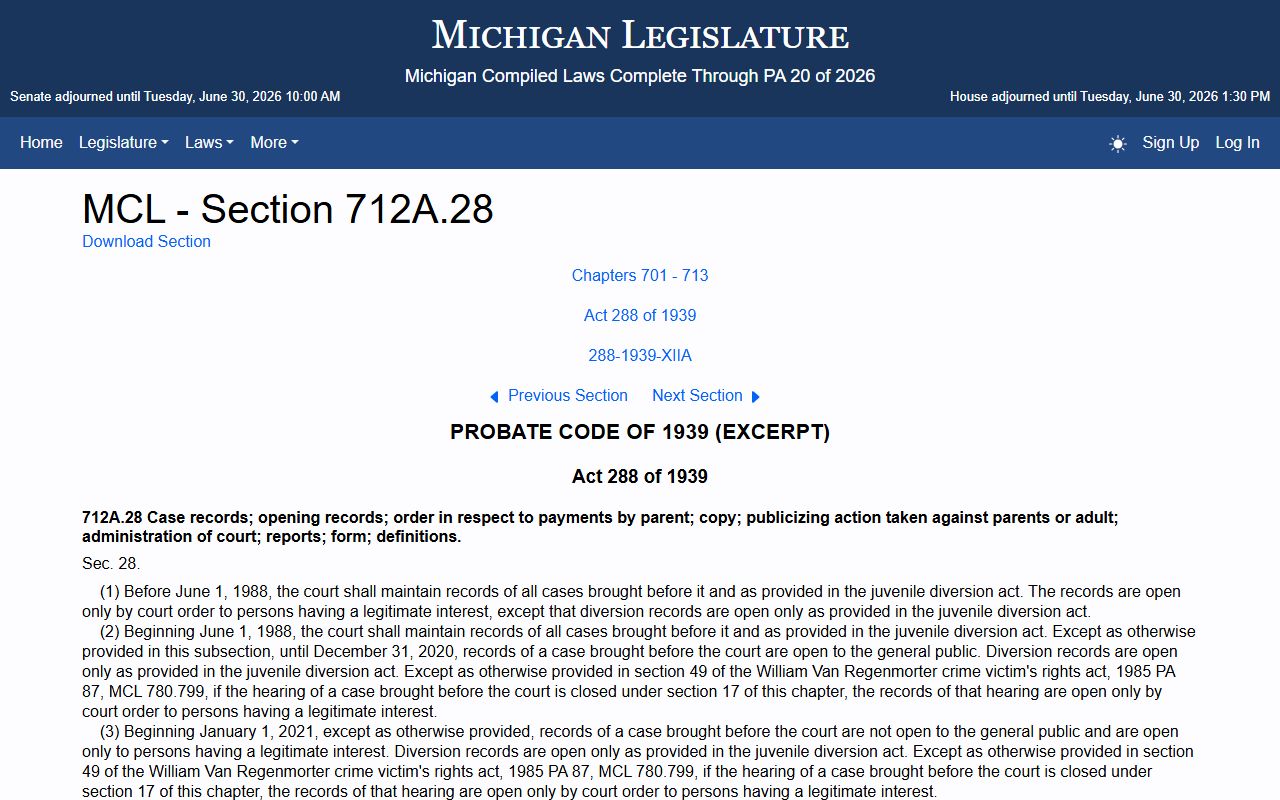
Juvenile case records are among the most protected. Michigan law limits who may see them and how they may be used.
MCL 712A.28 governs the confidentiality and retention of juvenile court records.
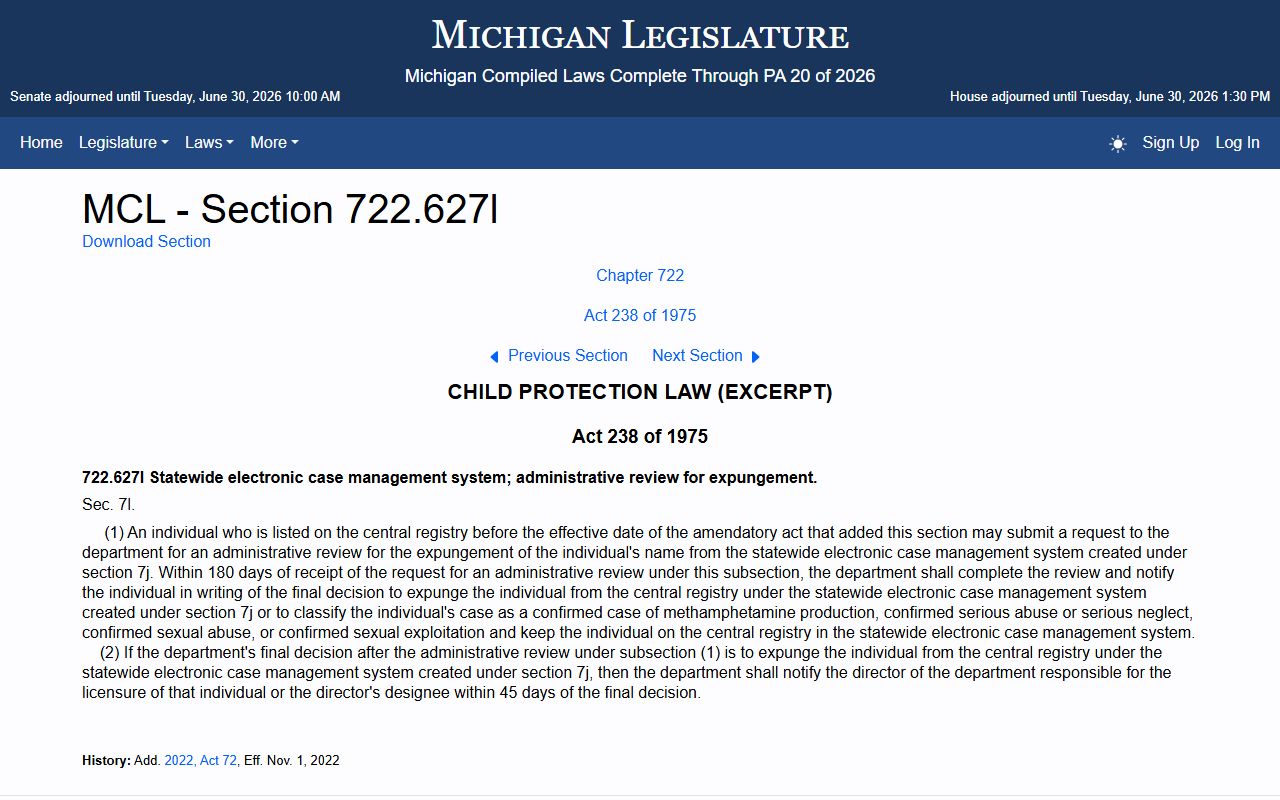
Child protective proceedings carry their own confidentiality rule. These files reach some of the most private facts a family court ever handles, and access is tightly limited.
MCL 722.627l sets the confidentiality standard for child protective records.
Beyond those categories, standard redaction rules apply. Birth dates, Social Security numbers, driver's license numbers, passport numbers, and financial account numbers are removed from public court files. Adoption records and some mental health proceedings are also closed. A case may stay visible on a docket while a sealed attachment inside it stays hidden by court order.
Probate and Family Division Structure
Antrim County runs a hybrid court. The Probate Court and the Family Division share the same bench, the same judge, and the same historic courthouse in Bellaire. That is why an adoption, a guardianship, and a name change can all land at one counter.
The setup shapes how records are found. Because probate and family work sit together, a searcher looks in one place for a wide span of household legal matters. The county clerk still holds circuit-court files and vital records, so a marriage or divorce file may involve a different office than a guardianship. Anyone comparing paths can review the county's marriage and divorce records before deciding where to file.
The practical takeaway is simple. Estates, guardianships, conservatorships, adoptions, and name changes all belong to the Antrim County probate and family court in Bellaire. Vital records and older circuit files route through the county clerk. Knowing that split turns a slow search into a short one.